Basic Combat
This section details basic ground unit combat.
Combat Structure
Time Sequence
Time
A combat Turn is assumed to be around 5 seconds. A combat Round is assumed to be a collection of these Turns performed near simultaneously. Ten combat Rounds is assumed to be about 1 minute.
Initiative
To determine the combat order, the characters make an Initiative Roll. The dice pool is composed of the character's Perception + Alertness + Guard Challenge initiative bonuses.
Each character has its Initiative dice pool rolled and higher Action Score totals go before lower ones. Critical Hits are counted as 2 hits.
Rounds
A Round starts when the highest initiative rolled party goes first. The round ends when the final Turn of the final faction is complete.
Turns
Each character in a faction gets 1 Turn. During the Turn the character can take 2 Standard Actions. The character can take up to five Free Actions in a Turn.
Spatial Movement
Basic Combat is not as concerned about the precision of spatial movements. Simply knowing roughly how far apart characters are is enough. To this end we use Range Bands. These Range Bands have specific distances associated with them, but in Basic Combat the Gamemaster and Players are encouraged to not worry about precise distances,
Range Bands
Blade (Melee) Range
Within 1-2 squares (2-4 meters) or the reach of the character, if the attacker is Large or larger, this distance can be increased to 4 meters or even more.
Thrown (Close) Range
3-7 squares away is Close Range.
Pistol (Medium) Range
8-12 squares away is Medium Range.
Rifle (Long) Range
13-24 squares away is Long Range.
Escape (Extreme) Range
25+ squares away is Extreme Range.
Range Band Movement
The precise distance moved is usually not important in Basic Combat. Instead we assume that a character can move about 10 meters in a turn and that means that they can go from Medium Range to Melee Range in a single turn. This also means that a character can go from Medium Range to Long Range in a single turn as well.
See the following chart for details. This chart assumes an average Agility, which produces a single Movement Action's distance as 5 squares or 10 meters.
Movement Actions to Traverse Range Bands
|
Blade (Melee) |
Thrown (Close) |
Pistol (Medium) |
Rifle (Long) |
Escape (Extreme) |
|
|
Blade (Melee) |
0 |
1 |
2 |
3 |
5+ |
|
Thrown (Close) |
1 |
0 / 2* |
1 |
2 |
4+ |
|
Pistol (Medium) |
2 |
1 |
0 / 4* |
1 |
2+ |
|
Rifle (Long) |
3 |
2 |
1 |
0 / 6* |
1+ |
|
Escape (Extreme) |
5+ |
4+ |
2+ |
1+ |
0 / 8* |
*In the best-case scenario, the character doesn't have to move to stay in the same range. In the worst case scenario, they have to move double to get to the other side.
Escaping
If all the PCs are at Extreme Range relative to hostile NPCs, they can choose to attempt to Escape. This is either a Athletics (Running) or a Sneaking roll, and essentially puts the PCs into a Chase game or the Stealth Game respectively.
Actions
Every character gets a Turn with 2 Actions. They can choose any two from a variety of Standard Actions. Standard Actions are defined as Actions which take very little time, such as 5 seconds or less. There are also Extended Actions, which can take several turns, and Free Actions, which can be combined with other actions and are not usually tracked.
Standard Actions
- Attacking: The character can perform an attack against another character within weapon range
- Change Defense: The character changes their Default Defense. The character will use this new Defense until it is changed again or the combat ends.
- Switching Weapons: The character can put away one weapon and draw a different weapon. If the character has the Quickdraw ability, this becomes a Free Action.
- Hiding: The character moves to break the line-of-sight of enemies and attempts to gain Concealment, which allows them to switch to the Stealth Game
- Quick Searching: The character attempts to find a hidden character or a single, obvious item.
- Mounting: Climbing aboard a vehicle to pilot it, or onto an animal to ride it.
- Aiming: The character spends an Action concentrating on hitting their target. Grants Reroll(2), which means that the player can reroll 2 of the attack dice.
- Concentrating: The character uses an Action to Concentrate, granting themselves a Focus Token.
In addition to the above Standard Actions, many of the Skill Checks constitute Standard Actions.
Example Free Actions
- Wield a weapon from a holster (back or hip)
- Drop an item
- Push a button
- Whisper to an Ally
- Shout a Warning
- Pull a lever
- Step through the space of an Ally
- Dismount a vehicle or animal mount
- Make 1 Emotional Attack
Extended Actions
Extended Actions are like Standard Actions in they are usually resolved as Attribute or Skill checks, but they take more than a single Turn to complete.
An example of an Extended Action is Computer Slicing. This can take anywhere from 1-10 Combat Rounds to complete, though the character might only make 1 roll during those turns.
Special Actions
Characters gain Special Abilities from their Species, Combat Style and Classes. Many of these Special Actions can also be performed in place of a Standard Action, but require the character spend a Resource first. Each of these Special Actions will describe how many "Actions" it takes to accomplish. If it says "Use an Action" then it can be used anywhere a Standard Action can be used.Resources
Special Actions typically take a Resource to Activate. In the case of Player Characters, this Resource can either be Motivation or Stress. For Non-Player Characters or NPCs, this Resource is always Stress. A character must be able to spend the Resource at the time that they Activate the Special Ability.
Moving
Characters can move a certain number of squares per turn. The distance moved is based on the character's Agility trait value or the vehicle's speed. If a character chooses to take a Movement Action on their turn, they gain a set amount of Movement Points, which they can then spend on their turn, either before or after another Standard Action.
Agility to Movement Points
|
Agility |
Movement Points (in Squares) |
|
1 |
4 |
|
2 |
5 |
|
3 |
6 |
|
4 |
7 |
|
5 |
8 |
Range Band Movement
By default the basic combat rules assume Range Band Movement. There is a table above in the section describing the space of combat, but as a general rule, anything within Close Range or farther will require at most 1 Movement Action to close the distance to another character. Anything equal to or further than Medium Range will require at least 2 Movement Actions to reach.
Map Movement
Map Movement is the other way to track character movement. When using a map with squares (or hexes) we calculate the distance a character can move based on their Movement Points (see table above). In normal conditions, each Movement Point allows for 1 square (or hex) of movement. This roughly corresponds to 2 meters.
Extra Movement
Characters can use both of their Actions to move their full Movement distance. This means that the character cannot attack the same turn they take this Extra Movement, but it also allows them to cover extra ground (i.e. Pistol (Medium) Range) to support an ally, pressure an enemy or potentially escape.
Difficult Terrain
Some terrain can be difficult to move through, so if a character moves through a space with Difficult Terrain they will expend double the Movement Points.
Threatened Spaces as Difficult Terrain
If a character wants to move past an enemy character, they must consider all adjacent spaces to the enemy as Difficult Terrain. This is special Difficult Terrain, as some characters have special abilities to negate this penalty.
Attacking
Basic Attacks
When a character attacks another character with a Basic Attack, they must create an Attack Dice Pool and roll it against the target's Defense Difficulty. By default this Attack Dice Pool will include only the weapon's Damage Dice. The attacking character can add dice equal to their associated Attribute if they are Proficient with that Weapon.
Attacking without a weapon by default gives the charaacter only 1 Attack Die (see Unarmed Fighting below).
Characters gain Weapon Proficiencies from their Combat Style and from some Class Levels
The defending character's Defense Dice Pool is equal to one of their four defenses: Armor Defense, Block, Dodge or Parry.
The Attacking character rolls their pool and counts Hits, Critical Hits and sometimes Focus results.
If a character uses an Action to Concentrate before their Attack, they can gain a Focus Token. If a Focus Token is spent before a roll, then the spending character can count all Focus Results as Hits. Some weapons also allow Focus Results to be counted as Hits, Crits or other Weapon Qualities
The Defending character rolls their pool and counts Evades, and sometimes Focus results.
Similar to Attacking, if a Defending character uses an Action to Concentrate, they gain a Focus Token. Using a Focus Token before a roll allows them to count all Focus Results as Evades.
If the Number of Hits from this Attack Dice Pool is greater than the target's number of Evades, that Attack was a success. Evades cancel Hits first, and then once all Hits are canceled, Critical Hits can be canceled by remaining Evades.
Any uncanceled Hits are counted as Damage against the defender and will reduce their Hit Points.
Any Attack that results in a reduction in Hit Points causes a Player Character to gain 2 Motivation.
NPCs do not gain Motivation, but may have other Abilities or Features which trigger when they lose Hit Points.
Critical Hits can cause increased damage if they exceed the target's Toughness + Resistance. (see Critical Strikes below).
If a character's Hit Points are reduced to Zero they suffer an Injury (see below), gain 2 Motivation and fall Unconscious.
Critical Strikes
If a player suffers uncanceled Critical Hits that exceed their Toughness + Resistance value, they have suffered a Critical Strike. A Critical Strike inflicts a Status Condition on the character that lasts until it is cleared or the Combat ends.
Melee Attacks
To perform a Melee attack, the target must be in Blade (Melee) Range. The attacker creates an Attack Dice Pool from the Weapon's Damage Dice and their Strength if they are Proficient with the utilized Weapon. If total Hits rolled is higher than the target's Evades, this is considered a successful attack. Normal Hits must be canceled before Critical Hits.
If a character is using an unarmed attack (no weapon) and is not proficient with Unarmed Fighting, they roll a single attack die.
- Melee Dice Pool
- (Strength, If Proficient with the Weapon) + Weapon Damage
Thrown Attacks
For a Thrown attack, the target must be in Thrown (Close) or Blade (Melee) to be hit without penalty. Pistol (Medium) and Rifle (Long) Ranges give the defender an additional +2 and +4 Defense Dice respectively. No Thrown Attacks can be made against characters at Escape (Extreme) Range.
The attacker then creates an Attack Dice Pool from their weapon's Damage Dice and their Strength or Deftness if they are Proficient with the weapon. Normal Hits must be canceled before Critical Hits.
- Thrown Dice Pool
- (Strength, If Proficient with the Weapon) + Weapon Damage
- Thrown Dice Pool
- (Deftness, If Proficient with the Weapon) + Weapon Damage
Grenades and Grenade launchers
These are special rules for Grenade Throwing/Launching because grenades do a very high amount of damage, they must be treated separately from the other weapons that use the attack and damage to mean the same thing.
When throwing a grenade a character must get a number of Focus results equal to the number of squares away they are trying to put the grenade. If the roll has an equal number or more Focus results, they throw/launch the grenade where they wanted to. But if they got less Focus Results than the distance, that means that the grenade failed to go where the user wanted. The GM rolls a 1d8 (or direction die) and calculates "north" prior to rolling. The result of the die is the direction that the grenade bounced. The number of squares it bounces is equal to the difference between the intended number of squares and the number of Focus Results. Once the grenade has come to a rest, it detonates. A player character can spend Motivation to react to the new position of the grenade (diving out of the way or using a Force power) but must announce this before the grenade detonates (the GM can count down 3, 2, 1, Explode!)
For Example, if Han Solo is trying to throw a frag grenade to a position that's 4 squares away from him, he needs 4 Focus Results. If he got 4 or more Focus Results, the grenade would land exactly where he wanted it and detonate as planned. However, lets say that he only got 2 Focus Results, this is not sufficient, so the GM says that the grenade dropped early. The GM shows north on the map and says that that's '1', and then rolls a direction die, getting a '3', which luckily for Han Solo, is the direction that he wanted it to go. The grenade bounces a number of squares equal to the distance between the needed results (4) and the results he got (2), which means it bounces 2 squares in the same direction. The GM counts down to detonation, but Han Solo just slyly grins, as if he meant it to do that.
Using a Grenade Launcher will add +3 Squares range, with or without Proficiency, however it also adds +3 Momentum, which means if the grenade misses its intended target (the player does not get the required number of "Focus" results), the grenade will bounce in a random direction with an additional momentum of +3.
Ranged Attacks
For a Ranged attack, the target must be in Pistol (Medium) Range if using a pistol-type weapon or Rifle (Long) Range if using a rifle-type weapon. If the target is at Escape (Extreme) Range, then the defender gains an extra +2 Defense Dice. Some level of Extreme Range precludes any type of attack.
However there is also a +2 Defense Dice bonus if the target is in Melee Range, as they are close enough to interrupt the attack with a melee strike.
The attacker creates an Attack Dice Pool from the weapon's damage dice and their Deftness if they have the appropriate Weapon Proficiency. If the total Hits rolled is higher than the Evades, the attack succeeds. Normal Hits must be canceled before Critical Hits.
- Ranged Dice Pool
- (Deftness, If Proficient with the Weapon) + Weapon Damage
Unarmed Fighting
A specific type of Melee Combat where the attacker is not wielding a weapon. This doesn't do as much damage, but it allows the attacker to choose between doing normal damage and non-lethal Stun Damage. If the attacker choses Stun Damage, it is applied against the target's Stress Capacity instead of Hit Points. This can also reduce the total number of Special Abilities that an NPC target can use, since their abilities all inflict Stress on the NPC.
- Unarmed Dice Pool
- (Strength, If Proficient in Unarmed Fighting) + Talent Bonuses
- Untrained Unarmed Dice Pool
- 1
- Martial Artist Unarmed Dice Pool
- 3 + Strength + Talent Bonuses
Grappling
Grappling is part of the Unarmed Fighting Proficiency, however it is complicated and as such is part of Advanced Ground Unit Combat.
Defending
All characters attempt to avoid being hit with attacks. These defenses use the Green Defense Dice.
All characters gain a Defense Bonus from their Armor. This Armor Defense is effective even if the target is taken by surprise.
Characters also have Active Defenses based partially on their Attributes and partially on their Equipment.
Armor can provide additional protection in the form of Resistance bonuses and the Defensive(N) Armor Quality. This Quality allows the wearer to count N Focus Results as Evades on their defense roll.
In the case of Active Defenses, if the character has a Focus Token, they can spend it in order to count all Focus Tokens as Evades for a defensive roll.
The Active Defenses provide additional defense dice and they fit into the Dueling System. What this means is that during a Duel these defenses can sometimes completely negate certain types of attacks, whereas the Armor Defense cannot.
Armor Defense
The clothing or Armor that a character is wearing often provides an Armor Deflection Bonus. This Bonus comprises the main part of the Armor Defense. Additional bonuses can come from a character's Species Features or Class-based Talents.
The Armor Defense is rolled even if a character is taken by surprise, where the other Active Defenses (usually) are not.
- Armor Defense
- Armor Deflection Bonus + (optional Species Bonus or Talents)
Characters may be surprised to find that wearing heavy armor can fully negate their Agility bonus, which can heavily affect their Dodge and Parry defenses. Not only that, but the Armor Agility Penalty applies to all other Agility-based Actions, such as Stealth and even normal Movement!
Active Defenses
There are 3 specific Active Defenses that characters can take:
- Blocking: The character uses a shield to intercept attacks.
- Dodging: The character dodges to an adjacent square to avoid an attack.
- Parrying: The character deflects the attack using a melee weapon or bracers.
Player characters can choose 1 of these 3 to be their Default Defense, which will be rolled whenever the character is not surprised.
The Focus Token can be spent on any of these Active Defenses to convert all Focus Results into Evade Results.
These defenses are derived from different Attributes, and so may be more effective for some characters, but they each have a way that the enemy can prevent the character from using that defense.
Blocking
Used when a character executes the Block Defense while being attacked. A character must be equipped with and wielding a shield to be able to Block. A character's Block is based on their Strength and Toughness, as well as any bonuses they get from their equipped Shield.
- Block
- Toughness + Strength + Shield Bonuses
Blocking is considered a Power Defense in the Dueling System.
Dodging
Used when a character takes the Dodge Defense to evade an attack. A character must be able to move to an adjacent square to be able to Dodge. A character's Dodge Defense Dice Pool is based on their Agility and Perception, but negatively affected by any Armor Agility Penalties they have. Dodging can also be negatively affected by an opponent's Grapple.
- Dodge
- Agility + Perception - Armor Agility Penalty
Dodging is considered a Quick Defense in the dueling system.
Parrying
Used when a character selects the Parry Defense to deflect an incoming attack. Most characters can only use Parry against Melee attacks, but the Martial Artist and the Lightsaber Duelist can use the Parry Defense against Thrown and Ranged attacks. A character must have a Melee Weapon or Bracers to be able to Parry without being Injured (the Steel Hands Martial Artist Talent can also be used).
- Parry
- Deftness + Agility + Parry Bonuses - Armor Agility Penalty
Parrying is a type of Finesse Defense in the Dueling System.
Other Actions
Aiming and Aimed Shots
If a character uses the Aim Action, then on their next Attack they can reroll 2 dice.
Characters can also try to hit a specific part of an enemy or target. This is different than just attacking, where it doesn't matter what specific spot you hit. This is also somewhat different from the Aim Action. To make an Aimed Shot, a character declares they are trying to hit a specific part of something and the Gamemaster declares a difficulty. This is translated into a number. The defending character gets that many extra Defense Dice added to their Defense Pool. If the player character does not end up hitting the target with this increased difficulty, they not only miss their specific target, but they actually miss their target completely. This is why the Aim Action and/or Concentrate Action can help with an Aimed Shot.
| Difficulty | Example | Target's Defense Bonus |
|---|---|---|
| Easy | Chest | 1 |
| Intermediate | Head | 2 |
| Challenging | Weapon Hand | 3 |
| Hard | Eye | 4 |
(Aimed Shots are not restricted to Ranged Attacks.)
Switching Weapons
A character often has multiple weapons for different circumstances. The most common sets are Melee and Ranged, but there can be other distinctions, such as length of weapon, damage type, and light/sound considerations.
To switch weapons is an Action if the player character wants to retain the old weapons, or if the weapons are buried in their backpack.
Why? Characters may drop what they have in their hands as a Free Action, and they can draw another weapon as a Free Action if the weapon is in a hip or back holster.
Some Special Moves, such as Quickdraw, include drawing and holstering a weapon as part of an attack, if those Special Moves are used, this Action penalty to switch weapons can be avoided.
Mounting a Vehicle or Animal
A character can jump into the cockpit of a vehicle or jump onto a riding animal as an Action. This action will likely be an Agility check, possibly with Acrobatics. The character can then roll a Piloting or Animal Handling check in a subsequent Action to move.
Hiding
To hide during combat a character must use a Stealth Action and gain Concealment. This Concealment can either be from Shadow or Cover. If the Concealment is from Shadow, they must be in a place with some darkness. If it is from Cover, there must be a physical object at least the same size as the creature doing the hiding. A character often uses their Observation Skill to find a good hiding spot.
A character has gained Concealment if no enemy has a Line-of-Sight to the hiding character. Many species have abilities to see through Shadow Concealment. Some species and special powers grant abilities to see through Cover Concealment as well.
Some Special Moves allow hiding as part of a Movement Action, but for most characters it will be a separate Action.
- Hiding Dice Pool
- Agility + Stealth +- Size Bonuses
The hiding character rolls their Hiding Dice Pool against the closest opposing character's Passive Alertness and gains a number of Stealth Tokens equal to the number of uncanceled Hits (with Critical Hits counting as 2 Hits).
So long as they have at least 1 Stealth Token in their pool, subsequent Actions and Turns that this character takes are now essentially part of a Stealth Encounter.
Quick Searching
Characters can search for clues, treasure or hidden opponents during their turn. This is an Action, and has effects on the character's Stealth Pool (if they are in Stealth, it costs 2 Stealth Tokens).
- Searching Dice Pool
- Perception + Searching
Depending on how a character is searching (quick glance vs slow and methodical) the GM may call for a different skill check and the number of Actions required to complete.
Special Moves
Combat Styles, Character Classes and Powers provide Special Moves. These Special Moves often behave like Standard Actions, but they are more powerful.
Special Moves also all have Attack Types. Unless otherwise specified, these Attack Types override whatever types the character's wielded weapons possess. This means that even if a character is weilding a Quick Weapon, if they use a Power Special Move, the Move's Type will always be Power.
The following are the default Special Moves. Class-specific Special moves are described in each Class' section and are part of the Talent Tree or is a Level Ability.
Special Moves for Player Characters can be activated either by spending Motivation or by suffering the same amount of Stress. NPCs can only activate their Special Moves using Stress.
Assassin
A close range and mobile fighter that sneaks up on enemies to execute surprise attacks using melee weapons.
Ambush
|
Type |
Quick Attack |
|
Cost |
1 Resource |
|
Target |
1 target unaware of the Assassin |
|
Effects |
This Quick Attack does extra damage from Stealth. This attack adds 1 bonus damage die per Stealth Token* that the Assassin has at the time of the attack. In addition the Assassin gains ½ of their Movement points they can use either before or after this move. |
*The Stealth Tokens must be on the “Stealth” side. Sneak Attacks typically cost 1 Stealth Token to perform, even if they miss.
Backstab
|
Type |
Quick Attack |
|
Cost |
1 Resource |
|
Target |
1 target facing the opposite direction |
|
Effects |
This Quick Attack does +2 extra dice of damage from the back, and reduces the target's Armor Defense by 2 for the rest of the Round. In addition the Assassin gains ½ of their Movement points they can use either before or after this move. |
Any Back Attack gets a +1 attack die, so the Backstab Special Move does 2 extra dice of damage beyond that (so 3 total). The reduction in Armor Difficulty would affect the target's Armor Defense as well as all of their Active Defenses. This effect lasts until the end of the round.
Narratively this attack surprises the target and makes them vulnerable to other attacks because they move in a way that reveals their less-armored parts.
Brawler
A close-up fighter that hits hard and with a wide arc to their attacks.
Haymaker
|
Type |
Power Attack |
|
Cost |
1 Resource |
|
Target |
1 adjacent target |
|
Effects |
Daze(2) (See Weaopn Qualities below). This Powerful Melee attack does 2x weapon damage to a single target (double the weapon's damage dice after weapon-specific bonuses), but after which the Brawler becomes Unbalanced (must roll their Acrobatics against their current Unwieldiness or will fall Prone). |
* The Daze(N) Weapon Quality can inflict the Dazed Status Condition if the number of Critical Hits (plus this N value) is greater than the target's Resistance score.
If the Brawler falls Prone they must use an Action to stand up.
Wild Swing
|
Type |
Power Attack |
|
Cost |
1 Resource |
|
Target |
Up to 3 adjacent targets |
|
Effects |
This Powerful Melee attack hits up to three targets directly adjacent to the Brawler*, gaining a +3 Bonus Damage Dice. The Brawler determines which direction they swing from. The first character that would be hit from that direction rolls their Defense Dice. Any uncanceled Hits can be applied to the target's Hit Points and then to the next target in the line, and so on until all hits have been applied or canceled. |
*The three adjacent targets must be contiguous in their positioning, in other words they must be in a line or bracket.
Gunslinger
A mid-range fighter that uses light ranged weapons effectively and is very mobile.
Pistol Whip
|
Type |
Quick Attack |
|
Cost |
1 Resource |
|
Target |
1 adjacent target |
|
Effects |
This Quick Melee move allows the Gunslinger to use any ranged weapon as a melee weapon. As a Melee Weapon it becomes a Bludgeoning weapon with 3 Damage and Stunning 2 [see Weapon Qualities in Ground Unit Combat]. The user can also move ½ their Movement before or after. The Gunslinger can choose to inflict Stun Damage instead of the normal Lethal Damage with this move, triggering the Stunning 2 effect*. |
*Can convert 2 Focus Results into Hits when inflicting Stun Damage.
Quickdraw
|
Type |
Quick Attack |
|
Cost |
1 Resource |
|
Target |
1 target in weapon range |
|
Effects |
This Quick Ranged Attack lets a Gunslinger use a holstered Weapon and immediately attack with a +3 Attack bonus. If the weapon was already drawn, they can instead immediately holster the weapon instead. In addition the user can move ½ their Movement. Finally, the Quickdraw move grants the learner a permanent +2 bonus to their Initiative Rolls. |
Heavy
A mid range fighter that uses heavy ranged weapons to control the enemy's movements.
Rapid Fire
|
Type |
Power Attack |
|
Cost |
1 Resource |
|
Target |
Up to 3 targets in a line or bracket within weapon range |
|
Effects |
This Powerful Attack requires a Ranged Weapon with the Spread Quality [see Weapon Qualities], it allows the Heavy to attack an area, doing damage to multiple targets in a 3 square line or bracket. The Heavy rolls an attack dice pool with +2 damage dice. In addition, this move grants Full Spread (each Focus result can be counted as a Spread). Each defender then rolls their defense dice as normal. Evade results cancel Hits and Critical Hits. The Heavy can choose how to apply any uncanceled Hits, Critical Hits and Spread to the targets. |
Normally a weapon with Spread(N) will allow the wielder to convert N Focus Results into “Spread”, each of which acts as 1 Hit to a character adjacent to their original target. If there is more than one effective Spread result, the attacker is able to choose which adjacent character(s) suffer these Hits. The affected target characters can defend as normal.
Suppressive Fire
|
Type |
Power Attack |
|
Cost |
1 Resource |
|
Target |
A line up to 9 squares or a 3x3 area |
|
Effects |
This Powerful Attack requires a Ranged Weapon with Spread, and it allows the Heavy to lay down suppressive fire to pin enemies behind cover, which in turn protects teammates as they move. Any opposing characters that move through the suppressed area must roll their Defense Dice against the full attack dice. In addition, this move grants Full Spread (each Focus result can be counted as a Spread). |
Medic
A mid range defensive fighter that can heal at a distance.
Stabilizing Shot
A Ranged Support Action which restores a small number of Hit Points to the target.
|
Type |
Finesse Attack |
|
Cost |
1 Resource |
|
Target |
1 target in Pistol (Close) Range |
|
Effects |
The Medic takes an Action and spends 1 Resource, they are able to fire/lob a healing bacta at a target within Pistol (Close) Range. They make a Ranged Attack against the target's Armor Defense. If they get at least 1 uncanceled Hit, the target recovers 1d4 +1 Hit Points. |
This move requires a source of Bacta.
Disabling Shot
|
Type |
Finesse Attack |
|
Cost |
1 Resource |
|
Target |
1 target in weapon range |
|
Effects |
Stunner(2). This Finesse Attack gains +2 Damage dice if the user is using a Stun Weapon or a Weapon on the Stun Setting. This move inflicts Stun Damage. If the total number of Hits exceeds the target's Stress Capacity, that target will fall Unconscious. Critical Hits count as 2 Hits for Stress*. In addition the attack gains Stunning 2 [see Weapon Qualities]. |
*The Stunner(N) quality allows the move to inflict the Stunned Status Condition if the number of Critical Hits (plus this moves N value) exceeds the target's Resistance score.
Sniper
A long range fighter that uses precision weapons to disable and wear down opponents.
Piercing Shot
|
Type |
Finesse Attack |
|
Cost |
1 Resource |
|
Target |
1 target in weapon range |
|
Effects |
This Finesse Attack reduces the target's Armor Defense by 2 for the rest of the Round if it hits, and the attack gains a +2 damage bonus. In addition this attack gains Piercing 2 [see Weapon Qualities]. This means that the attack can penetrate Armor Defense (4 total). |
Though this specific attack can pierce through 4 points of Armor Defense, any attacks made after that only benefit from a 2 point reduction in Armor Defense from the ability.
Crippling Shot
|
Type |
Finesse Attack |
|
Cost |
1 Resource |
|
Target |
1 target in weapon range |
|
Effects |
Hamstring(2) This Finesse Attack gains +1 Attack Dice and Vicious 1, regardless of the weapon used, which means at least 1 Focus Result becomes a Critical Hit. [see Weapon Qualities] |
*Hamstring(N) means that the attack has a chance to specifically inflict the Hamstrung Status Condition if the number of Critical Hits (plus the N value) is greater than the target's Resistance.
Reactions
Every Player Character, Elite and Boss NPC can use Reactions.
For a Player Character to React, they must spend 1 Motivation point or suffer 1 Stress and be reacting to something. Elites and Bosses can only use Stress. A Reaction is possible when a character is directly targeted by an opponent. A character can also React to an NPC character's Action, as long as they are within Close Range.
The default Reactions allow for Changing Defense or a Movement Action, but there are also special attack Reactions that are purchased as Talents from the martial Classes.
Triggered Reactions
Normally a character can only React to another if they are attacked by that character. Some Talents let a character perform an attack if an enemy passes through a threatened space.
An example is the Heavy's Suppressive Fire, which the Heavy designates a covered area, but doesn't roll an attack until an NPC moves into that area.
Damage, Conditions & Healing
This section describes damage types, conditions and how to recover from them.
Combat Damage
Characters are constantly attacking and defending in combat. As dice are rolled, any uncancelled Hits are typically marked as Damage against a target's Hit Points. Uncanceled Critical Hits are treated as 2 Hits, and they also have a chance to inflict a Status Condition.
Lethal Damage
By default damage in Combat is Lethal Damage and is marked against a target's Hit Points. If a character's current Hit Points ever reach zero, they immediately suffer from 1 Injury and are knocked Unconscious. (see Injuries).
Critical Hits are marked as 2x Hits against a target's Hit Points.
Stun Damage
Certain weapon types and attack types do Stun Damage instead. This damage is marked against the target's Stress Capacity instead of their Hit Points. If the total Stress is greater than their Stress Capacity, the character is knocked Unconscious but does not suffer an Injury. Stress is cleared after an 8 hour rest.
Critical Hits of Stun Damage are treated as inflicting 2 Stress.
Since Stun Damage does not result in a loss of Hit Points, Player Characters do not gain 2 Motivation from taking Stun Damage/Stress.
Environmental Damage
Characters can take damage from the environment, coldness, heat, radiation, toxins and vacuum.
Too Cold
If the environment is very cold and the character does not have cold weather gear, every hour each character must make a Challenging(4) Resistance check. This check can be augmented with Species Abilities and Talents.
If they fail they suffer 1 die of Cold Damage per hour, cumulative. So one die the first hour, two dice the second hour, etc.
Too Hot
If the environment is very hot and the character does not have gear for hot conditions, every hour each character must make a Challenging(4) Resistance check. This check can be augmented with Species Abilities and Talents.
If they fail they suffer 1 die of heat Damage per hour. So one die the first hour, two dice the second hour, etc.
Radiation
If the environment has dangerously high radiation levels and the character doesn't have the appropriate gear, they automatically suffer 1 Injury every hour. There is no Resistance roll.
Toxins
If the environment is poisonous or acidic and the character does not have gear for these conditions, every hour each character must make a Resistance check. This check can be augmented with Species Abilities and Talents.
If they fail they suffer 1 die of poison Damage per hour, cumulative. So one die the first hour, two dice the second hour, etc.
Vacuum
If the character is in a vacuum or cannot breathe because of another issue, each minute the character cannot breathe they suffer 1 Injury.
Conditions
There are four types of Conditions that a character can suffer in Combat:
- Status Conditions: these are temporary conditions that temporarily reduce the character's effectiveness.
- Battle Conditions: these are temporary conditions that pose a tactical threat to the character.
- Morale Conditions: these are emotional states that the character can automatically recover from after the battle.
- Injuries: these are cumulative conditions that are a long-term threat to the character.
Status Conditions
These conditions are temporary and typically last either 1 Round or until the end of Combat. They can be cleared by the First Aid skill with an Intermediate(3) difficulty.
Some Weapons or Special Abilities inflict specific Status Conditions, but the table can also be rolled on for those times when a Status Condition is inflicted by a Critical Strike instead.
Status Condition Table
|
Roll |
Condition |
Effect |
|---|---|---|
|
1 |
Insensate |
The character cannot perceive their surroundings. They get a -5 dice penalty to Ranged or Thrown Attacks and a -2 Penalty to Melee Attacks. They get a -5 to the Dodge and Parry Defenses and a -2 to the Block Defense. These penalties cannot reduce an Attack or Defense dice pool below 1. |
|
2 |
Incommunicado |
The character is unable communicate with others. |
|
3 |
Stunned |
The character is stunned and loses 1 of their Actions on their next Turn. |
|
4 |
Hamstrung |
The character's movement is halved. |
|
5 |
Weakened |
The character's physical attributes are all at -1. |
|
6 |
Dazed |
The character's mental attributes are all at -1. |
|
7 |
Shocked |
The character also suffers the same amount of Stun Damage |
|
8 |
Wounded |
The character suffers 1 unavoidable Lethal Damage each turn |
Battle Conditions
There are conditions which may not be based on damage, but instead happen because of specific events in the battle. These are temporary and can be recovered from quite easily during combat.
Battle Condition Table
|
Condition |
Effect |
|---|---|
|
Unconscious |
The character is has been knocked unconscious or is sleeping. They can be roused by another character as an Action, or the character in question can spend 1 Motivation to regain Consciousness at the beginning of their next turn. |
|
Grappled |
The character's Movement Speed is cut in half as they are less able to move while being grappled. They also cannot perform the Dodge Defense while grappled. In addition, grappled characters can be Pinned, Tripped or Thrown as a Free Action on the grappler's next turn. |
|
Prone |
A character that is Prone on the ground has their Armor Defense doubled against Thrown and Ranged Attacks, but halved against Melee attacks. In addition, if the prone character is defending and ends up receiving a DOMINATE, they take double damage, if they get in a CLASH, they roll 1/2 the dice, and even in a REPEL they must roll against the attacker (using the normal defense dice). Prone Characters must spend a Movement Action to stand up on their Turn. |
|
Unbalanced |
The character has lost their balance, they must roll their Acrobatics against their Unwieldiness and get at least 1 uncanceled Hit or fall Prone. If an Off-Balanced character is Shoved or Tripped, they automatically fall Prone. Extras automatically fall Prone. Characters that fall Prone take 1 die of damage. Prone Characters must spend a Movement Action to stand up on their Turn. |
Morale Conditions
Morale Conditions are inflicted by Emotional Attacks. These conditions last anywhere from 1 minute (if inflicted during combat) to 1 day (if applied meticulously outside of combat).
Morale Conditions Table
|
Condition |
Effect |
|
Frightened |
The character cannot approach the thing that scares them, difficulties are treated as +2 when taking actions other than fleeing. Inflicted by Intimidation. Being subjected to more Intimidation (or Fear) effects once already Frightened can result in Stress equal to the number of uncanceled Hits. |
|
Enraged |
The character will try to attack their enemies every turn. Inflicted by Insults. |
|
Bribed |
The character will do the minimum to uphold their end of the bargain. Inflicted by Negotiation. |
|
Charmed |
The character will not attack the target while they are in this condition. The character will also be compelled to do whatever they can to help the target of their infatuation. Inflicted by Charm. |
Injuries
If a character is reduced to zero Hit Points, they fall unconscious and become Injured. Player Characters have 6 Vitality Points. Each time a Player Character becomes Injured, they mark off one of their Vitality. If they are at zero Vitality and they take an additional Injury, they will die.
Unlike Hit Points, Injuries cannot be healed easily. A character must receive healing from a Doctor or Augmentor, or spend one hour in a Bacta Tank per Injury to be healed. Without the Bacta Tank, a Player Character will heal 1 Injury per day of rest in a safe, clean place, such as a hospital or a ship's medical bay.
When a Doctor or Augmentor is trying to restore Vitality, they must perform a Medical Challenge against the Injured Character's level of Injury. If they fail, the character can become more injured.
The Injured character displays 1 symptom per Injury Sustained. The Gamemaster rolls a 1d6 and consults the following table to determine the symptoms. That player character must then act out those symptoms and the Medic must guess what they are in order to beat the challenge.
Injury Symptomps Table
|
Roll |
Meaning |
Symbol |
|
1 |
Fatigue |
|
|
2 |
Abnormal Temperature |
|
|
3 |
Trouble Breathing |
|
|
4 |
Dizzy or Nauseated |
|
|
5 |
Pain |
|
|
6 |
Reroll |
-- |


Healing
Characters can heal different types of damage at different rates. The damage and healing are shown below in recovery order from fastest to slowest.
Recovering from Stress
Characters completely recover from all Stress after an 8 hour rest. Characters also recover from Stress if they are KO'ed and wake up again.
Healing Hit Points
Hit Points can be healed during combat by the First Aid skill, the Stabilizing Shot, the Augmentor's Healing Power and by Bacta Vials.
Outside of combat, characters heal 1 Hit Point per hour of rest.
Curing Injuries
Injuries can be cured via the Medicine skill, a Bacta Tank, the Augment's Healing Power or slowly over time. Every full 8 hours of rest will cure 1 Injury on the character.
Ability: Stabilizing Shot
The Medic's Stabilizing Shot ability can restore 1d4 + 1 Hit Points per application.
Augmentor's Power: Healing
For each “Hit” rolled, the target regains 1 Hit Point. Critical Hits count as 2 Hits.
To heal Injuries, the Augmentor must purchase the Stimulate Regrowth talent. This will cause the subject to regrow limbs and organs quickly, and will also cause them to recover from 1 Injury per hour.
Skill: First Aid
Using the First Aid Skill is a Standard Action which can restore Hit Points to a damaged character or stabilize a dying character (with zero Vitality).
For the First Aid to heal, the Medic rolls their Intelligence + First Aid + Bonus Healing Talent points, and the number of Hits is the amount of Hit Points healed. Critical Hits count as 2 points of healing.
Skill: Medicine
There are two different ways to treat an Injury. The Simple Method and the Challenge.
Simple Treatment of Injuries
A Medic can use the Medicine skill outside of combat to help their target recover from Injuries. They roll their Intelligence + Medicine skill against a difficulty based on the number of Injuries. The GM rolls Defense Dice equal to the number of Injuries. The Medic must have at least 1 uncanceled Hit to heal that Injury. Only 1 Medicine Skill attempt can be made per 8 hour period. Each uncanceled Critical Hit can cure another Injury.
Medicine Challenge
If a Medic or Healer is attempting to heal an Injury during combat, they must defeat a Medicine Challenge. They must take an Action to roll the Medicine Challenge die. To successfully heal 1 Injury, they must get 2 Progress per Injury. If the "Pain" result is rolled, the target being treated suffers 2 Stress. All other symptomatic results are recorded. The Medic can take an Action to treat the Symptom, or they can continue to roll the Medicine Challenge die. Any untreated Symptoms will remain for 1 hour after the Treatment is completed.
Item: Bacta Vials
Bacta Vials are items that can restore Hit Points to biological creatures. They are purchased from clinics on high-tech worlds and can be stored for up to 1 year without degredation in effectiveness.
The Doctor can create Bacta Vials with the appropriate raw materials.
| Name | Hit Points Healed |
|---|---|
| Tiny Bacta Vial | 1d4 Hit Points |
| Small Bacta Vial | 2d4 Hit Points |
| Medium Bacta Vial | 4d4 Hit Points |
| Large Bacta Vial | 8d4 Hit Points |
Item: Bacta Tanks
A character has 1 Injury cured per hour of time spent submerged in a Bacta Tank. In addition, after 10 minutes, all that character's Hit Points will be healed.
Rest without Treatment
Most characters have 1 Hit Point healed per hour of rest and 1 Injury cured per 8 hours of rest.
Injuries, Dying & Death
All player characters can suffer up to 6 Injuries and survive. However the 7th Injury will be "Dying". If a character that is Dying (has sustained 7 Injuries) is not cured of at least 1 Injury within 1 minute, that character Dies. A Dead character can be brought back to life within 10 minutes by the Doctor's or Augmentor's Ultimate Abilities.
If a character remains Dead for more than 10 minutes, they are Dead permanently and the player should make a new character.
Weapons
Weapon Properties
Weapons have the following Properties:
- Name: the name of the weapon
- Tech Level: the Tech Level of the weapon: Primitive, Modern or High Tech
- Range: Blade (Melee), Thrown (Close), Pistol (Medium) or Rifle (Long) Ranged
- Weight: Light, Medium or Heavy
- Qualities (Optional): any special qualities or effects the weapon has and how to trigger them
- Damage Type: the damage type of the weapon
- Rarity: how rare the weapon is, which determines how hard it is to find and the weapon's cost multiplier.
- Cost: how much the weapon costs without adjustment for Rarity
Weapon Qualities
Weapons have special Qualities that can be triggered by using one or more Focus results.
Each quality will be listed next to a weapon with a number from 1-5. This number indicates the maximum number of Focus results that can be used to activate this special quality.
If a weapon has more than 1 quality which can be triggered, the player or GM can decide which qualities trigger.
- Accurate: Each point of Focus up to the number can be converted into a Hit.
- Cleaving: Each point of Focus up to the number can allow damage to be split across an additional target in Melee range.
- Impale: Focus Results can be converted into additional damage behind the adjacent target.
- Defensive: Each point can be used as an Evade on the next defense action, or when used in a Parry, as an Evade for that CLASH.
- Disarming: Each point can be used to inflict an automatic Disarm on the opponent, in addition to the Focus Results.
- Piercing: Each point allows a Focus to penetrate 1 Armor Defense on the target. If the target does not have sufficient Armor Defense for this penetration effect, it adds additional damage instead.
- Spreading: Each point causes a Focus to convert to 1 Hit which strikes a Ranged or Thrown target that is adjacent to the original target.
- Stunning: Each point turns a Focus into 1 Stress against the target's Stun Points.
- Ionic: Each point turns a Focus into 1 Stun for Droid characters, or reduces Energy Shields by 2 Hit Points.
- Vicious: Each point can convert a Focus into a Critical Hit.
- Targeting: Each point can reduce a Range Band penalty by 1.
- Burning: Each point does an additional point of damage on the following Round.
- Grappling: Each point acts as a point of Grappling, potentially ensnaring the target if they fail their Grappling counter roll.
- Blinding: Each point acts as an attack against a target's sight, all in the radius must roll Resistance to avoid being inflicted with Insensate for 1 Round.
- Deafening: Each point acts as an attack against a target's hearing, all in the radius must roll Resistance to avoid being rendered Incommunicado for 1 Round.
- AOE: Burst(N): Each number indicates a larger burst radius.
- AOE: Splash(N): Each number indicates a larger splash radius.
- AOE: Arc(N): Each number indicates the length of the conical arc.
- Slow Loading(N): Each number indicates an additional Action required to load the weapon.
- Stunner(N): Each number indicates a bonus to inflicting the Stunned Status Condition, which is norally inflicted by random if the number of uncanceled Critical Hits against a target is greater than its Resistance.
- Hamstring(N): Each number indicates a bonus to inflicting the Hamstrung Status Condition, which is norally inflicted by random if the number of uncanceled Critical Hits against a target is greater than its Resistance.
- Weakening(N): Each number indicates a bonus to inflicting the Weakened Status Condition, which is norally inflicted by random if the number of uncanceled Critical Hits against a target is greater than its Resistance.
- Daze(N): Each number indicates a bonus to inflicting the Dazed Status Condition, which is norally inflicted by random if the number of uncanceled Critical Hits against a target is greater than its Resistance.
- Shocking(N): Each number indicates a bonus to inflicting the Shocked Status Condition, which is norally inflicted by random if the number of uncanceled Critical Hits against a target is greater than its Resistance.
- Wounding(N): Each number indicates a bonus to inflicting the Wounded Status Condition, which is norally inflicted by random if the number of uncanceled Critical Hits against a target is greater than its Resistance.
An example is: Vicious 2: This weapon can have a maximum of two Focus results converted into Critical Hits
Weapon Categories
There are several different Categories of Weapons: Tech Level, Range and Weight.
There are three Tech Levels of the weapons:
- Primitive - iron-age tech level or below
- Modern - space-age tech level
- High Tech - hyperspace-age tech level or above
And there are four different Ranges where the Weapons are effective:
- Blade (Melee) - melee-range weapons that use Strength, can be bladed, spiked or weighted
- Thrown (Close) - close-range weapons that use Strength or Deftness, can be bladed, spiked, weighted or explosive.
- Pistol (Medium) - medium-range weapons that use Deftness, can cause piercing or energy damage.
- Rifle (Long) - medium-range weapons that use Deftness, can cause piercing or energy damage.
Finally there are three different Weights where a certain level of Strength is required to use the weapon:
- Light - lightweight weapons that are easy to hold, require a Strength of 1.
- Medium - medium-weight weapons that are hefty, require a Strength of 2*.
- Heavy - heavy-weight weapons that are difficult to hold, require a Strength of 3*.
*If a character is attempting to use a weapon that exceeds their Strength, they must perform a Strength Check against a difficulty equal to its weight requirements just to use the weapon each round.
If the weapon is 1 weight level above the character's strength, the difficulty is +2 (2 defense dice added to target).
If the weapon is 2 weight levels above the character's strength, the difficulty is +4 (4 defense dice added to target).
If the character fails, they cannot use the weapon, drop it, and their Attack Action is wasted.
Each weapon is a combination of tags from the three Categories.
These tags are mostly for Narrative purposes or to determine what weapons are available on which worlds.
|
Primitive |
Modern |
High Tech |
|
|
Melee |
Clubs, Knives, Swords |
Vibro-blades, Vibro-axes |
Lightsabers |
|
Thrown |
Throwing Knives, Throwing Axes |
Vibro-blades, Concussion Grenades, Shrapnel Grenades |
Photonic Daggers, Plasma Grenades |
|
Ranged |
Blow guns, Bows, Crossbows, Slings |
Railguns, Slugthrowers |
Blaster Pistols, Blaster Rifles, Blaster Turrets, Laser guns |
Character Weapon Proficiencies
Characters can learn a variety of Weapon Proficiencies. Each proficiency is part of a group, either Melee, Thrown or Ranged weapon proficiencies (Unarmed Fighting is a Melee proficiency, even though it does not use a weapon).
- Axes[St]
- Blades[St]
- Clubs[St]
- Lightsabers[St|De]
- Staves/Spears[St]
- Unarmed Fighting[St|De]
- Whips/Flails [De]
- Grenades[De]
- Throwing Axes[De]
- Throwing knives[De]
- Thrown Weapons[St|De]
- Grenade Launchers[De]
- Heavy Weapons[De]
- Pistols[De]
- Rifles[De]
- Artillery: Beam[De]
- Artillery: Missile[De]
- Artillery: Mine[De]
- Artillery: Grapple[De]
- Stun Weapons[De]
- Exotic Weapon Proficiency (one per weapon)
Each Weapon Proficiency is boolean, you either have it or you don't.
If a character is using a weapon that they don't have a proficiency with, they add only the weapon's Damage Dice to their attack Dice Pool.
However, if a character is using a weapon that they have a Proficiency with, players can add a bonus which is equal to the associated Attribute.
- Damage Bonus
- Attribute, If Proficient with the Weapon
Example: So if Han Solo, who is Proficient with Pistols and has a Deftness of 3 is using a Blaster Pistol (damage 2), he gains a total Attack Dice Pool equal to 5 (2 weapon damage + 3 Deftness).
However if Han Solo tries to use Chewbacca's Bowcaster, with which he is not proficient (a Bowcaster is an Exotic Ranged Weapon, and as such is it's own Weapon Proficiency), so he rolls only the Bowcaster's Damage (4) so his total attack dice pool is 4.
Makeshift Weapons
A character can attempt to use anything as a weapon, though some things will obviously just not work. A pillow or plate of noodles probably won't be usable as a weapon under any but the most extreme circumstances, however a sharp stick, broken bottle, chair or engineering tool may be more easily used. These Makeshift Weapons have their Weapon Damage provided by a roll [1d4 - 1]. This is to represent that 25% of the time, an item is totally useless as a weapon.
|
Roll |
Weapon Damage |
|
1 |
0 |
|
2 |
1 |
|
3 |
2 |
|
4 |
3 |
Makeshift weapons cannot have a Proficiency Bonus under normal circumstances. Only the Explorer class has the ability to become proficient in these improvised weapons.
Armor
Armor Properties
Armor has the following Properties:
- Name: the name of the armor
- Material: what material the armor is made out of, determines how quickly it degrades from hits.
- Tech Level: the Tech Level of the armor: Primitive, Modern or High Tech.
- Weight: Light, Medium or Heavy, etc.
- Bulk: How bulky the armor is when stored.
- Deflection: This is used to form a character's defensive bonuses (Default Defense & Block).
- Resistance Bonus: How much this armor increases Resistance to avoid Injury and Environmental Hazards.
- Qualities: what special qualities or effects the armor has
- Damage Threshold: how much damage the Armor can take before it is destroyed.
- Rarity: how rare the armor is
- Cost: how much the armor costs
Armor Qualities
Similar to the Weapon Qualities, Armor can have qualities which are triggered by using one or more Focus results. These will be listed in the armor entry and inclue a number from 1-5. This number is the maximum humber of Focus results that can be used to trigger this quality. If more than one quality can be used, the player or GM determines which one(s) are triggered.
- Augmenting: The armor improves a character's attributes or skills in a specific way.
- Fortifying: Focus results can be converted into a temporarily higher Resistance.
- Protective: Focus results can be converted into Evade results.
- Reflective: Focus results can be used to reflect Hits back at the attacker.
- Restorative: Focus results can be used to heal 1 Hit Point on the wearer.
- Spiked: Focus results can cause Melee attackers to take Hits.
Shields
Shields are critical for the Block defense. There are several shields in use in the worlds of Starchasers:
- Physical Shields: physical shields, take no power but slowly degrade unless maintained. Except for the first entry, Physical Shields are considered Modern technology.
- Primitive Materials: These primitive shields are only functional against Primitive weapons.
- Hardened Steel (Durasteel): Standard protective shielding is made from this material, it is light and strong. Particularly strong against Modern and Primitive weapons.
- Adamantine(Beskar): the strongest metal in the galaxy, this protects against even Photonic attacks and is almost indestructible.
- Orichalcum(Cortosis): though not as strong as Adamantine, this metal disrupts the energy fields of Photonic weapons, causing them to dissipate harmlessly. It is less strong against Modern or Primitive weapons though.
- Energy Shields: energy shields require a battery that depletes through use and must be recharged after battle and replaced during the heat of combat. Energy Shields are High Tech tech level.
- Directional Shields: requires less power to maintain, but only protects from one direction.
- Spherical Shields: requires much more power, but creates a protective shell around the character.
- Psychic Shields: special shields made out of psychic energy
- Directional- similar to Energy Shields, these psychic shields can be directional
- Spherical- similar to Energy Shields, these psychic shields can be spherical
Shields have the following properties:
- Name: the name of the shield
- Material: the material that the shield is made out of (Physical Shields only)
- Tech Level: the tech level of the shield; Primitive, Modern and High Tech
- Energy Requirements: the type of Energy Cell needed to power the shield (Energy Shields only)
- Shielding Duration: How many rounds the shield can protect the user (Energy Shields only)
- Weight: Light, Medium or Heavy
- Block Bonus: The main advantage of a shield is the bonus it provides for the Block maneuver.
- Damage Type Resistances (Optional): a set of Damage Types that the Shield is Super Effective against (double the Armor's Difficulty Bonus)
- Damage Type Weaknesses (Optional): damage that the shield is Weak against (Armor Difficulty is halved and the shield takes 2x damage).
- Damage Threshold: how much damage the Shield can take before it is destroyed.
- Qualities: any special qualities or effects that the shield has
- Rarity: how rare the shield is
- Cost: how much the shield costs
Physical Shields are assumed to be Effective against most types of Damage. Some may be Super Effective against certain types (meaning that the Shield or Armor won't degrade when being hit by that type of damage). If a Physical Shield is Weak to a type of damage, it will still block it, but it will degrade twice as fast.
Energy Shields must be Attuned to a specific set of Damage types, for which they are considered “Effective”. Any damage type they are not attuned for is assumed to pass through the Energy Shield harmlessly.
Most Energy Shields have settings for:
- Physical Damage: includes Bludgeoning, Slashing, Piercing, Kinetic and most Vibrational damage.
- Energy Damage: includes Heat, Cold, Ionic, and some Sonic damage.
- Photonic: includes Light damage from Lightsabers and Laser weapons and Plasma weapons such as Blasters
And because Photonic is currently the widest-used damage type aboard starships and space stations, most Personal Energy Shields are set to Photonic Damage as the default to resist.
Shield Qualities
Shields have the same potential qualities as both Armor:
- Fortifying: Focus results can be converted into a temporarily higher Resistance.
- Protective: Focus results can be converted into Evade results.
- Reflective: Focus results can be used to reflect Hits back at the attacker.
- Restorative: Focus results can be used to heal 1 Hit Point on the wearer.
- Spiked: Focus results can cause Melee attackers to take Hits.
- Knockback: Focus results push opponents back by 1 square each.
Advanced Combat
Advanced Actions
Disarm
The Disarm action is treated as a special case of the Aimed Shot. The attacker hoping to disarm their opponent target's their Weapon Hand, which is a Challenging (3) difficulty. They must succeed in the attack (the Defender can roll any defense they normally would) but in addition the defender gains +3 defense dice. The attacker must get at least 1 uncanceled Hit or they miss the target completely.
Grapple
Grappling is part of the Unarmed Fighting Proficiency.
Characters can attempt to grab others to restrain them and perform additional attacks against the grappled target. An attacking character can create a Grapple Dice pool from either their Strength or their Agility, depending on whether they are grappling with their upper-body or lower-body, respectively.
- Grapple Dice Pool
- Strength (+- Size bonus or penalty) + (Athletics, if Proficient in Unarmed Fighting)
- Grapple Dice Pool
- Agility (+- Size bonus or penalty) + (Acrobatics, if Proficient in Unarmed Fighting)
The defender rolls their Defense Dice Pool as normal.
If the number of Hits/Crits exceeds the number of Evades, the target becomes Grappled.
Once a target is grappled, they cannot move until they break free, either as an Action on their turn, or as a Reaction. This means that the target cannot use the Dodge Defense (see below) because they cannot move to an adjacent square.
This also means that the grappling character also cannot perform the Dodge Defense, unless they release their Grapple.
A character attempting to break free from a Grapple can roll either Strength or Agility to get free (and the corresponding skill of Athletics or Acrobatics if they are proficient in Unarmed Fighting). They must equal or beat the number of Hits as the Grapple check to get free.
If a character has another Grappled, then as a Free Action on their following Turn they can perform a Grapple-Attack.
The standard Grapple-Attacks are Pin, Trip, or Throw. Classes unlock new Grapple Attacks.
- Pin: A Finesse Attack which pins the target to the wall or floor, preventing them from moving until they break free. (Strength or Agility to get free). The Grappler must maintain their position to keep the target pinned, but can otherwise take any Action. The Grappler can also inflict Stun Damage equal to their Strength/Agility as a Free Action. The defender can only use the Block or Parry defenses.
- Trip: A Quick Attack that causes the target to become Unbalanced, the defender will fall Prone and potentially take falling damage if they fail a Acrobatics roll. The Grappler can move 1 Square after the Trip.
- Throw: A Powerful Attack which launches the grappled target into the air, where they must make a Acrobatics check or fall Prone and take falling damage based on their Size Category (and the specific gravitation of the world they are on).
The damage from Pin, Trip or Throw is the number of Hits on a dice pool which comprises:
- Grapple-Attack Dice Pool
- Strength + (Athletics, If Proficient in Unarmed Fighting) + Talent Tree Bonuses
- Grapple-Attack Dice Pool
- Agility + (Acrobatics, If Proficient in Unarmed Fighting) + Talent Tree Bonuses
The defending character rolls their Acrobatics Dice Pool to reduce the effectiveness of the Grapple-Attack. If the defending character gets enough Evades on this roll to cancel all Hits (and Critical Hits) then the Grapple-Attack fails.
If a character falls into another character, both will potentially take falling damage. Characters can normally only roll Default Defense dice to lessen this damage. The falling damage dice pool is calculated as 1 plus the number of meters fallen divided by 3, but the maximum cannot exceed 10 damage dice on a planet with Standard Gravity and may be less or more depending on the gravity of the world the character is falling on.
- Falling Damage Dice Pool
- 1 + (Meters Fallen / 3) [Max = Gravitational Acceleration]
Damage Types
Though there are a variety of thematic damage types, the only ones that matter tactically are Lethal Damage and Stun Damage. However Stress is further divided between weapons that do Ionic damage which is Stress for Droids and Vehicles, and Shocking Damage which is the Stun Damage for biological creatures. You'll note that these are synonyms for each other. That's because both damage types are really the same thing, just with different frequencies, voltages and amperages.
Lethal Damage
Lethal Damage is done by most weapons, the Hits of which are marked against a target's Hit Points. Critical Hits mark 2 Hit Points. The number of Critical Hits from Lethal Damage are also compared against the character's Resistance and must be equal or below it to avoid suffering a Status Condition.
Stun Damage
Stun Damage is done by Unarmed Attacks and Stun Weapons (and Ionic Weapons for Droids and vehicles). Stress is marked against a target's Stress Capacity for each point of Stun Damage that is not canceled. If the Stress of a character equals their Stress Capacity, that character is knocked Unconscious and must spend 1 Motivation to regain consciousness (or be Shaken Awake by an ally later). However if a character awakens after being knocked unconcsious, all of their Stress is cleared.
Surprise Attacks
When one or more characters attack one or more characters that are completely unaware of them (often due to Stealth), that is a Surprise Attack. These Surprise Attacks come with advantages for the attacker.
Surprise Round
The main advantage is that all of the attacking characters gain 1 Round before the surprised targets can take actions. This is often enough to determine who will win the battle.
Armored Defenses Only
In addition, during the Surprise Round, the surprised defenders can only use their Armor Defense if they are the target of a Surprise Attack.
Special Moves
There are a number of Special Moves that can dramatically increase damage done from a Surprise Attack. Many of these need to be the first attack performed, as they gain benefits from Stealth.
Assassin Style: Ambush
The Ambush special ability can do extra damage if performed from Stealth. This does +1 attack die per Stealth Token.
The number of Stealth Tokens that a character has is based on their starting Stealth Pool as well as their choices during the Stealth Encounter.
Spy: Improved Ambush
Spies upgrade this damage to 2 dice per Stealth Token instead of 1, however using this move empties the Spy's Stealth Pool.
Scoundrel: Sneak Attack
Scoundrels have the Sneak Attack ability. This ability scales with the Scoundrel, starting with a simple +1 attack die at level 0 and ending with +6 attack dice at level 18.
Scoundrel: Ambuscade
Scoundrels have a Special Move called Abuscade, which gains Vicious (N), where N is the number of Stealth Tokens that the Scoundrel had unused. This move can be combined with Sneak Attack or Ambush.
Scoundrel: Bushwhack
Scoundrels have a Special Move called Bushwhack, which can affect (N) creatures, where N is the number of Stealth Tokens that the Scoundrel had unused. They make a single attack against this group, and each surprised member can only use their Armor Defense.
Positioning
The Position and Orientation of individual ground units can be very important in Advanced Combat. From Back Attacks, Flanking and High Ground, the relative position of two combatants can mean several levels of bonus dice or potential penalties.
Some Classes and Species gain benefits from having Positional Advantages over their opponent.
Back Attacks
An attack aimed directly behind a target can do additional damage and catch them off guard.
By default an attack aimed at a target's back will do +1 die of damage.
Special Moves
Certain Combat Styles and Classes have Special Moves which can take advantage of Back Attacks.
Assassin: Backstab
The Backstab special ability does +2 extra attack dice from the back, and reduces the target's Armor Defense by 2 for the rest of the Round. This +2 extra dice are in addition to the normal Back Attack +1 bonus, putting the total to +3.
Flanking
Flanking is when a target becomes surrounded by enemies. Flanking begins when at least two allied opponents are attacking the same target at Melee Range.
In Advanced Combat Flanking reduces a target's Dodge dice pool by 1 for each Flanking Opponent (after the first, who is not yet flanking). When enough enemies surround a target, this can completely reduce the target's Dodge, potentially to the point where they could have zero or even negative dice in their Dodge pool. However, no defense can ever be reduced below 1*
*This is the subset of the rule that no dice pool can ever be reduced below 1 die.
Pack Tactics
A character with the Pact Tactics Feature gains +2 Attack Dice whenever they attack a target that an ally of theirs is already Flanking.
High Ground
If a character has the High Ground (is at least 2 meters above the target character) they gain +2 to any Attack dice pool against that target.
Opportunistic Attacks
A character with the Opportunistic Attacks Feature gain +2 Attack Dice whenever they have an advantage over their target. This includes Back Attacks, High Ground and Surprise Attacks.
Area of Effect Attacks
Most weapons strike a single target. But a few weapons can hit additional targets. Usually these weapons will strike all characters in a single area, or additional units directly adjacent to the main target.
When these weapons are used, there are five separate ways that damage is applied across an area:
- Cleave: Split damage across adjacent Melee targets
- Impale: Split damage across Close targets in a line
- Spread: Focus Results count as Hits to adjacent targets
- Box, Bracket, Line, Cone: Damage is split across all targets in the Shape
- AOE: Damage dice are halved repeatedly at specific radii
Melee Weapons
Some Melee Weapons have qualities that allow them to hit additional targets.
Cleave
Weapons with Cleave(N) can hit additional targets in Melee range which are adjacent to the attacker. Each Focus result up to N can be converted into a Hit against an adjacent character. The attacker can determine where these additional Hits are allocated. Targets can defend as normal.
Prefer targets that are in a contiguous line or bracket.
Impale
Weapons with Impale(N) can hit additional targets that are behind the original target. Each Focus result up to N can be converted into a Hit against a character behind the original target. If there are multiple characters behind the target, the closest must suffer Impale Hits equal to at least half of the original attack before Impale can be applied to targets behind that.
Some Ranged and Thrown weapons may also have Cleave or Impale, but these are Exotic Weapons.
Thrown & Ranged Weapons
Some Thrown and Ranged Weapons have the Spread Quality which allows the damage to "bleed over" onto adjacent targets.
Spread
Weapons with Spread(N) allow N Focus Results to be treated as Hits against targets that are adjacent to the original target or area. These adjacent targets get any normal Defense.
Automatic Weapons
A good number of Ranged Weapons can fire automatically. This allows them to target entire areas to lay down suppressive fire or do damage to a wide array of targets. By default these weapons split rolled Hits amongst all targets. In addition, the targets are each able to defend separately.
If a Weapon has the “Autofire” quality, this means that it is an automatic weapon and can target three types of areas:
Box
Automatic weapons can target a 2x2 box area instead of a single target. Damage must still be split between targets within the area though.
The Heavy can target a 3x3 area for their Suppressive Fire ability.
Bracket
One of the structures that Automatic Weapons can hit targets in an “L” shaped bracket. The value of the “Autofire” indicates the size of the Bracket. In the following diagrams, the ‘#” represents a target and the “A” represents the rough position of the attacker.
|
Spread Number |
Bracket Size |
|
1 |
# # # A |
|
2 |
# # # # A |
|
3 |
# # # # A # |
|
4 |
# # # # # A # |
|
5 |
# # # # # # A # |
Line
The other structure that Automatic Weapons can hit is in a simple line. Usually this line will be “wide” rather than “deep”.
|
Spread Number |
Line Length |
|
1 |
3 |
|
2 |
4 |
|
3 |
5 |
|
4 |
6 |
|
5 |
7 |
Box
The Heavy Combat Style has learned to hit enemy targets in a different pattern than a line or bracket. They can target a square “box” for their Suppressive Fire ability (or a line 9 squares wide):
# # #
# # #
# # #
A
The Soldier has an improved version which allows them to suppress a slightly larger area.
# # # #
# # # #
# # # #
# # # #
A
Spread
The Spread(N) weapon quality means that Focus results on an attack roll can represent Hits on targets adjacent to the original target.
AOE Damage
For Explosives and Grenades use an AOE pattern of how the damage applies and drops off:
Grenades and Explosives usually have a radius(N). When you make an Area Attack with such a weapon, you must decide where to center the radius before you make the attack roll. The center of an AOE is always a single square.
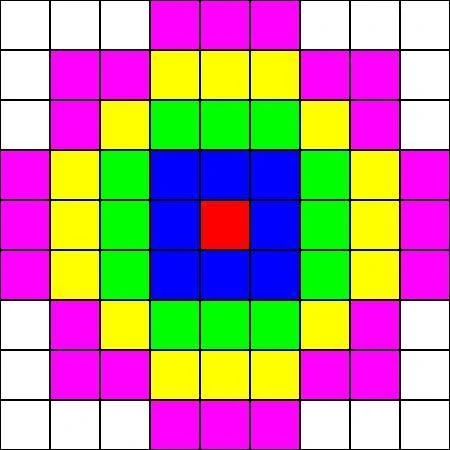
The red square is no AOE. Blue Squares are 1-Square AOE. X AOE means you have a circle with Radius X. That means the Green Squares are Radius 2, the Yellow Squares are Radius 3, and the Purple Squares are Radius 4.
Radius outside of the AOE is considered the "Half Damage" area. The size of this "Half Damage" area is the same as the initial Radius. This means that an AOE(2) would have 2 radii squares of full damage and 2 radii squares of half damage.
Flamethrowers
Flamethrowers and some other weapons and Force Powers do damage in a “Cone”. Cone(N), where N is the length of the Cone in squares:
Cone-2
# #
#
Cone-3
# # #
# #
#
Etc.
Cones
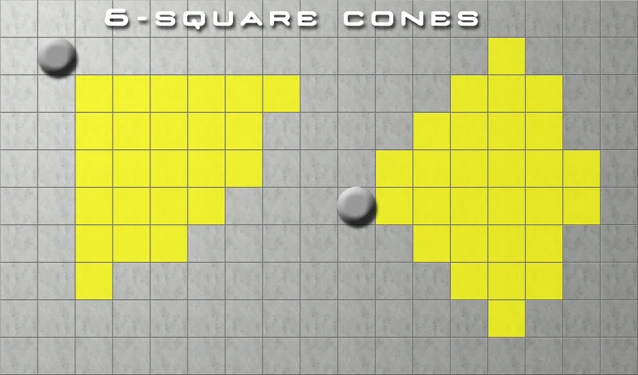
Force Powers
Force Powers use many different AOE shapes. Typically they use Damage Splitting.
Line-of-Sight
Ranged and Thrown Attacks require line-of-sight from the attacker to the target. To determine if a character has line-of-sight during miniature map combat, the attacker must be able to draw a line from one corner of their character's square to two corners of their target's square.
If a character doesn't have line-of-sight, they cannot make a Ranged Attack. Thrown Attacks however can be made, but the defender is considered to have Full Cover.
Blinded characters cannot gain Line-of-Sight to anything.
Characters that wish to use the Hide action during combat must break all Line-of-Sight from any enemy unit to themselves (ally and neutral units are not counted).
Cover
Characters can find large objects to hide behind during combat. These objects provide Cover, automatically reducing the damage taken from incoming Ranged and Thrown attacks.
These sources of Cover provide a Damage Soak.
Damage soak is simply subtracted from incoming damage before the target rolls any defense. Normal Hits are removed before Critical Hits.
Cover that has an effect on Melee attacks is called a shield.
Cover is also relative to the focus of the attack. What may be Cover from a Ranged Attack may not be Cover to a Grenade thrown over the Cover.
Partial Cover
Partial Cover is provided by any objects that are in the same size category as the character. So a Medium character hiding behind a Medium tree would gain Partial Cover.
Partial Cover provides 3 Soak against incoming Ranged and Thrown Weapon attacks.
Full Cover
Full Cover comes from objects that are at least 1 size category greater than the character. So a Medium character hiding behind a Large boulder would gain Full Cover.
Full Cover provides 6 Soak against incoming Ranged and Thrown Weapon attacks.
The rules for Cover work with creatures instead of Objects, however creatures move, which reduces their value as cover by 1.
So a Medium Creature hiding behind another Medium Creature only gets 2 Soak.
And a Medium Creature hiding behind a Large Creature only gets 5 Soak.
Cover Concealment
Cover can also provide Concealment from enemies, which grants a chance to enter Stealth. The character hiding behind Cover must have Concealment from all lines-of-sight from enemy units.
Shadow Concealment
Shadow Concealment is the Concealment that a character obtains from darkness and shadow. It can provide a way for characters to enter Stealth as well. It also can act as Partial Cover, since the attackers cannot see the target to aim properly, but there is also nothing obstructing their attacks.
In practice the GM can treat most Shadow Cover as a Partial Cover, since it can make it hard for the enemy to target the character.
Dueling System
The Dueling System is designed for speedy, exciting tactical combat.
The Gamemaster will often use it for Boss Battles or other climactic combats.
The way this works is that with the Dueling System, each character's attack or defense is categorized as one of three types:
| Move Type | Description |
|---|---|
| Power | The move uses Strength and often get bonus dice or an AOE effect. |
| Finesse | The move has increased chance for Critical Hits or a technical move like disarm. |
| Quick | The move adds additional movement or has a chance to hit first. |
Type Strengths and Weaknesses
Each attack or defensive Action will be associated with one of the three types. This means that every attack or defense will be Strong against one type, Weak against one type and The Same as the last type which means they are neither strong nor weak against each other.
- Power is strong against Finesse and weak against Quick
- Finesse is strong against Quick and weak against Power
- Quick is strong against Power and weak against Finesse
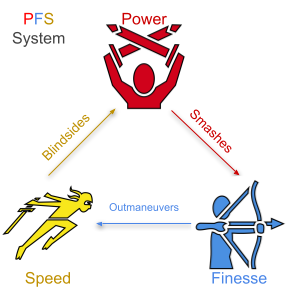
Examples:
In Dueling, Blocking is a Power Defense. It is weak to Quick Attacks, since they can be unpredictable and strike from strange angles.
Dodging would be a Quick Defense. It is weak to Finesse Attacks, since they rely on timing and tempo, which can allow an opponent to anticipate a Dodge.
Parrying is a Finesse Defense. It is weak to Powerful Attacks, since they are capable of overwhelming a deflecting defense.
The attacks and defenses in the Dueling system happen simultaneously, and they can be resolved quickly based on the types of the moves involved:
- Attack is Strong against Defense: DOMINATE!
- Attack and Defense are the same type: CLASH!
- Attack is Weak against Defense: REPEL!
If the defender cannot perform their defense, this is considered an automatic DOMINATE!
Each of these states have an immediate effect:
DOMINATE!
The attacker does full Damage to the defender. No additional roll is needed. The attacker also gains 1 Motivation.
CLASH!
The attacker and defender roll their dice pools and resolve normally:
- The attacker rolls their normal Attack Dice Pool
- The defender rolls their normal Defense Dice Pool
- Hits are canceled by Evasions first
- Critical Hits can be canceled by Evasions if all Hits are canceled first.
- Leftover Hits do 1 damage to the defender.
- Leftover Critical Hits do 2 damage to the defender.
- A character that takes damage immediately gains 2 Motivation.
REPEL!
The defender takes zero damage. No additional roll is needed. For the defender, some types of weapon, shield or armor properties (such as Knockback) may also trigger.
The defender also gains 1 Motivation.
Timing of Attacking and Defending
Attacking and defending in the Dueling System happen Simultaneously. The player character selects a Maneuver (Basic Attack, Active Defense or Special Ability) and the GM rolls for the NPC to see which move they use. If the result is a DOMINATE!, or REPEL!, no further roll is necessayr. However if the result is a CLASH!, then the two sides roll their Attack Dice Pool and Defense Dice Pool normally.
Dueling Turn Order and Flow
Duels don't use normal Initiative and Turn Order rules. Instead they go by a Combat Flow System.
In a Duel, one character begins as the Active Fighter. They have the initiative and start by attacking. The primary target must select defenses to try to prevent the attacks from succeeding.
The Active Fighter is often the NPC Boss, though a single PC can also begin the duel if they are not surprised.
The Active Fighter continues to attack so long as they get DOMINATE! results. The Active Fighter can choose to attack a different target if they are withing Thrown (Close) Range.
If a defender gets a REPEL!, they immediately become the Active Fighter instead and can begin a counter-attack.
A Player Character who is not the Active Fighter can spend 1 point of Motivation to jump into the Duel and attempt an Attack or Defense. If they get a DOMINATE! or REPEL!, then they become the Active Fighter. Player Characters who are not currently part of the Duel can only attempt this every 3 Interactions (i.e. every 3 times a character gets a DOMINATE!, CLASH! or REPEL!).
A CLASH! can cause the Active Fighter to change as well, depending on whether the attacker's attack still succeeded.
Ending a Duel
A duel usually continues until one of the two sides can no longer go on. It is also possible that both sides choose to end the duel.
Grappling
In the case of a Grapple attempt, if the attacker gets a DOMINATE!, they are also able to immediately use one of the 3 Grapple-Attacks (Pin, Trip or Throw). If the choice is Pin, then the defender gets a chance to break out of it immediately. If the defender breaks out, then the duel continues. If they don't, then the duel's momentum may be lost and things may return to Normal Combat or a Social Challenge until something changes.
Bosses will typically only use 1 type of Duel Die to determine which moves they use. The PCs can slowly learn which die this is based on their attack patterns. Bosses can have multiple phases, however, and if they do each phase can use a different Duel Die.
Allies, Companions & Pets
Allies are story-based Non-player Characters (NPCs). They are meant to aid the party, but should not overshadow them or be difficult for the Gamemaster to play.
Pets are animal or droid companions that accompany a specific Player Character and follow their orders. Pets should provide some tactical advantages but should be quick to run as well.
Companions are the Explorer class' upgrade of the Pet concept. Companions have special Abilities and are more effective in Combat and Stealth, but are still meant to be simpler than a player character.
For the remainder of this section, any description of Allies also applies to Pets and Companions as well, the major difference being who is running them (GM or Player), but the underlying mechanics are the same.
Diceless Combat
Allies don't roll Initiative, and instead always go after the last Player Character. Allies have their own Turns and have two Actions per Turn. Still Allies only make 1 Attack per Turn, using the other Action for Movement or environmental interaction.
Diceless Attacks
All Allies potentially have 3 Attack values:
- A Blade (Melee) Attack
- A Thrown (Close) Attack
- A Pistol (Medium) Attack
Allies usually try to get into the range of their Strongest of the 3 Attacks.
If an Ally is within range of an enemy NPC, the GM can have them make 1 Attack. To do so the GM compares the Attack Value of the approprate Ally Attack against the Default Defense of the NPC. If the Ally's Attack Value is greater than the defense value, the Ally does an amount of normal damage to the NPC equal to the difference between their Attack and the NPC's Defense.
Example: Luke Skywalker has a Melee Attack of 9. He moves adjacent to the Gamorrean Guard and is then in range. The Gamorrean Guard has a Default Defense of 3. This means that Luke does 6 damage to the Gamorrean Guard. However, if the Gamorrean Guard were to Block, their defense value would be 6, and they would only take 3 damage.
Diceless Defenses
Allies have four Defense values:
- An Armor Defense
- A Block
- A Dodge
- A Parry
In the same diceless way as their attack, these Allies defend by examing the Dice Total for an attacking NPC and subtracting the appropriate Defense Value from it. If the enemy NPC's attack value is higher than the Ally's Defense Value, they take damage equal to that difference.
If there is a question about which Defense the Ally uses, just go with the highest one they can currently perform.
If the enemy has any Weapon Qualities, instead of rolling, simply add half of the Quality Number to the attack.
Example: Another Gamorrean Guard lunges at Luke Skywalker. The Guard's highest attack is the Piercing Strike, which has 5 attack dice, however the attack has Piercing 2. The GM adds 1 of those to the Gamorrean's attack, bringing it up to 6. Luke's Default Defense is 3, so he would take 3 damage. Since Luke is in Blade (Melee) Range he could potentially use his Parry(7), which would deflect the Gamorrean Guard's attack completely each turn he used it.
Hit Points, Injuries and Healing
Allies have Hit Points and Stress Capacity that are calculated in the same way as Player Characters. If they take damage during combat, the GM must track those numbers (Hit Points and Stress inflicted). But because the Allies always interact with Diceless Actions, they can never get Criticals (they can also never inflict Criticals).
If an Ally is reduced to zero Stun Points from Stress, they are knocked Unconscious like a player character but are uninjured. If they instead are reduced to zero Hit Points, they are likewise knocked Unconscious, but this time they suffer from 1 Injury, just like a Player Character would.
However, any Injuries that the Ally suffers are just tracked against their Vitality, they do not suffer from the Status Conditions that Player Characters, Elites and Bosses do.
This means that Allies can die in battle, though it would take several consecutive combats with no healing for this to happen, and the Ally would likely show that they were injured, allowing the player characters time to heal them before they expired.
Allies are healed in the same way as player characters. If an Ally rests for 8 hours it is assumed that they recover from all Stress, regain 8 Hit Points and heal 1 Injury.
Special Abilities
Story-based Allies and Companions have Special Abilities. Pets do not.
Depending on their level, the Explorer may be able to assign multiple Special Abilities to their Companions.
There are broadly two types of Special Abilities for Allies:
- A Special Attack
- A Passive Ability
An Ally can have up to 4 Special Attacks assigned to them at a time, but they can only have 1 Passive Ability.
Passive Abilities can be powerful and often inflict Stress and so can only be used a certain number of times per battle.
Special Attacks also often inflict Stress and so can only be used a few times per combat.
Allies in Duels
Allies will have numbers for Dodge, Parry and Block, as well as their Armor Defense. They can also have a Ranged, Thrown and Melee attack, all of which must have a Type (Power, Finesse or Quick) and a numeric value.
Of course, not all Allies will have non-zero numbers in each attack type, but this simply makes them tactically weaker than a Player Character, which is as it should be.
Any Special Abilites that Allies have will also be typed.
This will allow the Allies to be used in the Dueling System without much effort.
The major change is that the Ally doesn't have Motivation, so the GM will have to inflict 1 Stress each time an Ally attempts to jump into the Duel.
Allies as Absent Player Characters
The GM can make Ally Cards for each Player Character that is missing from a session, to make running their characters easier. To do so, they can transfer the normal attributes and defenses directly over from their full character sheet.
Ally Statistics
Allies have a simple subset of all the statistics of a player character, and have more in common with NPC Extras.
Ally Stats
| Statistic | Description |
|---|---|
| Name | The name of the Ally, Companion or Pet |
| Role | Whether this is an Ally, Companion or Pet |
| Size | Small, Medium or Large |
| Species | The Species of the Ally |
| Strength | Their Strength |
| Toughness | Their Toughness |
| Agility | Their Agility |
| Deftness | Their Deftness |
| Inteligence | Their Intelligence |
| Perception | Their Perception |
| Charisma | Their Charisma |
| Confidence | Their Confidence |
| Movement | Their Movement Speed |
| Melee | The dice total of their strongest Melee attack. Inclues its Duel Type |
| Thrown | The dice total of their strongest Thrown attack. Includes its Duel Type |
| Ranged | The dice total of their strongest Ranged attack. Includes its Duel Type |
| Default Defense | Their Default Defense |
| Block | Their Block |
| Dodge | Their Dodge |
| Parry | Their Parry |
| Acrobatics | Their Acrobatics |
| Athletics | Their Athletics |
| Resistance | Their Resistance |
| Emotional Control | Their Emotional Control |
| Hit Points | Their Hit Points |
| Stress Capacity | Thier Stress Capacity |
| Injuries Suffered | How many Injuries they suffered |
| Alertness | Their Alertness skill (value only) |
| Stealth | Their Stealth skill (value only) |
| Observation | Their Observation skill (value only) |
| Passive Alertness | Half of their combined Perception + Alertness score |
| Searching | Their Searching skill (value only) |
| Virtues | Their Virtues |
| Flaws | Their Flaws |
| Passive Ability | The Ally's Passive Ability |
| Special Attack 1 | The Ally's 1st Special Attack |
| Special Attack 2 | The Ally's 2nd Special Attack |
| Special Attack 3 | The Ally's 3rd Special Attack |
| Special Attack 4 | The Ally's 4th Special Attack |