Slicing System
Objective(s)
- Obtain a specific piece of Data
- Run a specific Program using the Compute power obtained
Slicing Challenge
In the Major Slicing Challenge, the Technician must navigate a Computer System to find the Data they are looking for, or access enough Compute power to run a Program.
A Slicer can run a system “Raw” the way that an ordinary Technician would do so, or they can use a sophisticated piece of Slicer software known as a “Proxy”. Since there are only benefits and no downsides to using a Proxy, all Slicers do so.
When a Slicer uses a Proxy, the damage done to it by enemy ECMs is done to the Proxy and the Slicer suffers no Stress.
Space
Each computer system or droid brain starts with a small map roughly 6x6. However, instead of the action taking place within the squares, it instead happens at the points where two perpendicular lines cross.
Example Blank Map

The GM will draw various links from a starting place to several ending spaces. This can be generated with a Dungeon Generation Die (see below).
Example Map with only Links

On each nexus, as well as anywhere the GM feels makes sense, they add a little circle, this is where the Question Tokens, Node Tokens and Gate Tokens for the challenge will go.
Example Map as Technician Sees it Initially
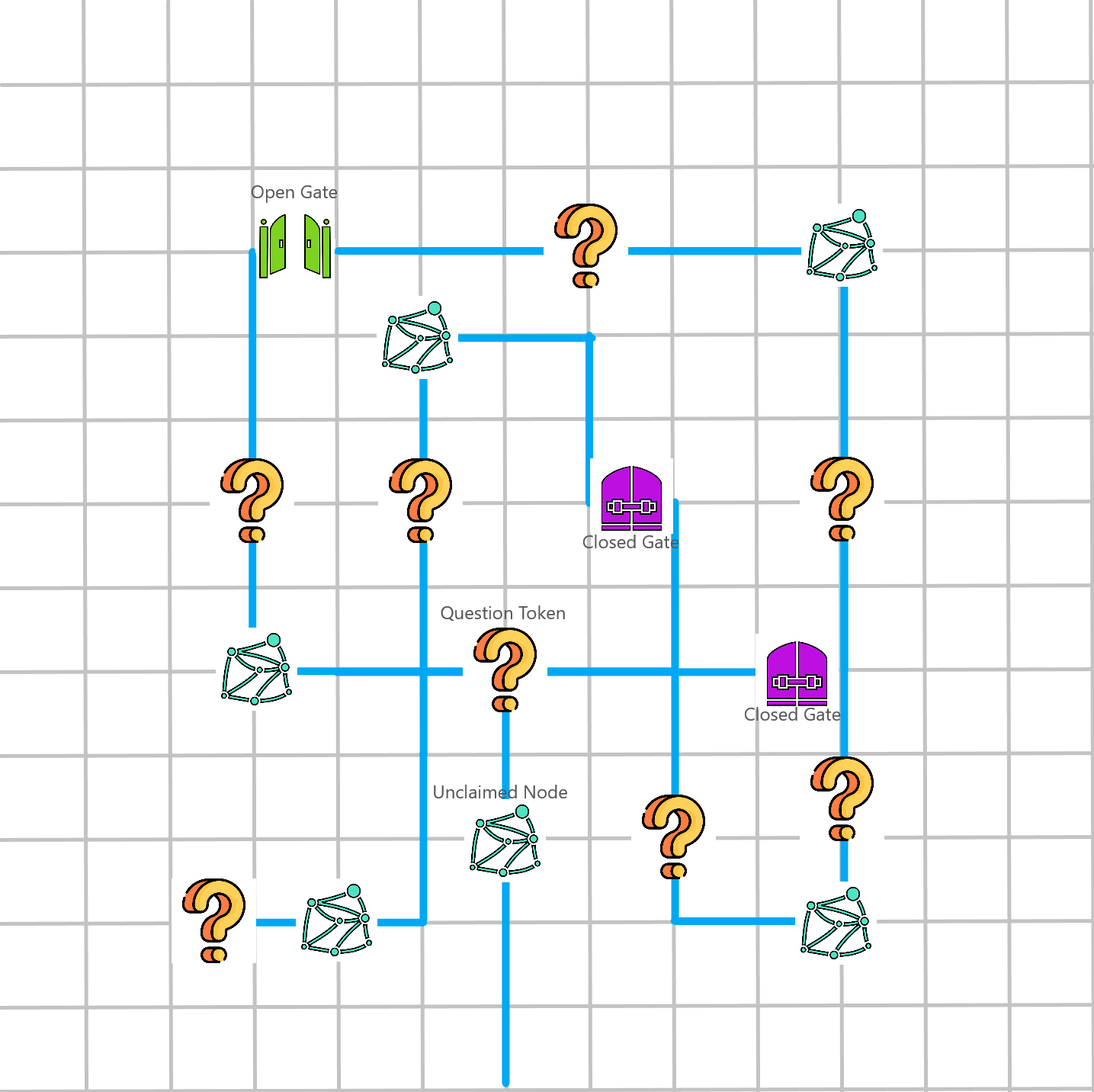
Once the Tokens are in place, the computer map can be presented to the Technician. This is the map they will explore when attempting to gain access to the computer and claim the Nodes to use as Resources.
Example Map Fully Revealed
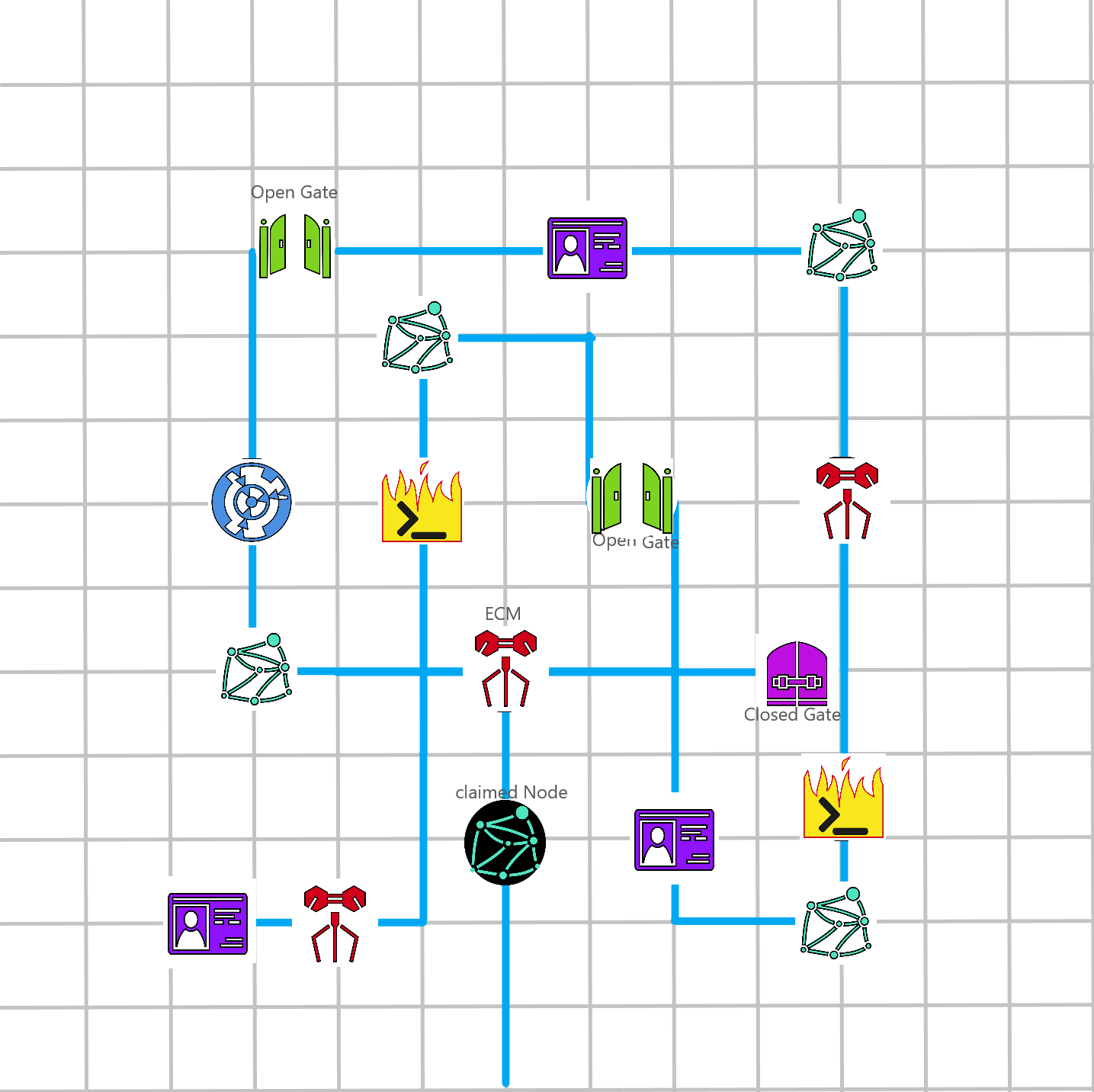
One by one as the Technician explores the computer system map, they will flip the Question Tokens and Claim Nodes. Sometimes this will result in resources, such as Nodes or Data. Other times this will result in obstacles, such as Firewalls and ECMs. The Technician must either reveal enough unblocked Nodes to run the Program they need, or they must find the hidden Data that they are seeking.
The Slicing Challenge Die is used differently with True Slicing. In this case it is rolled by the GM, who adds additional tokens to the map, or potentially even changes the map (links between nodes are added and removed).
Compute Resource
During a Slicing Encounter the Compute Nodes are resources that can be used. The Slicer can use them to activate Deck and Proxy abilities and to Run Programs.
A Slicer can claim any Node that they (or their Proxy) passes over as they move.
If a Slicer claims a Node, they flip it from White to Black, and then on the Upkeep phase of their turn, they gain 1 Compute Token.
Movement
During their turn, a Slicer can move their Proxy a number of squares equal to its Movement score.
Time
This section describes the different temporal concepts in a Slicing Encounter.
Phases
The Slicing Encounter has three phases:
- Setup: The GM sets up the board, and the Slicer can roll a single “Discovery” roll.
- The Run: One or more Rounds of the Slicer and Computer System taking Turns and Actions.
- Extraction: The Slicer decides they are done and can keep 1 piece of data per Link as they Disconnect
Rounds
The Slicing Encounter will have one or more Rounds. A Round is complete when every Slicer has had a Turn, the System has had a Turn and every still Rezzed ECM has had a Turn.
Turns
Each turn has 2 Actions. A Slicer Action can be a Movement Action or a Standard Action. The System has its own specific Actions, as do ECMs.
The Slicer Turn has three phases:
- Upkeep: The Slicer gains 1 Compute for each claimed Node
- Play: The Slicer can perform their 2 Actions and spend Compute.
- Garbage Collection: Any unused Compute is discarded.
Actions
Slicer Actions
The Slicer Actions for the main Slicing game are a superset of those for the Slicing Challenge. The new ones involve moving around the map (Move) and interacting with the tokens therein (Search, Access).
|
Action |
Description |
|
Overclock |
The Slicer obtains 1 extra Compute, but suffers 1 Stress. |
|
Disconnect |
The Slicer forcibly disconnects to remove all Traces. However, the Slicer Loses 2 Links in the process. If the Slicer was Engaged with an ECM, their Combat immediately ends. |
|
Brute-Force |
The Slicer spends 2 Compute to Breach a Firewall-Prompt but also gains 1 Trace. |
|
Guess |
The Slicer can attempt to guess the password to a Firewall-Prompt. This password will be an 8-letter word. The Slicer can roll their Computers skill, each Hit will reveal 1 unique letter of the password to the Technician, making guessing it slightly easier. The Slicer can Guess 3 times a turn. Making 3 inaccurate guesses will cause the Slicer to lose 1 Link. |
|
Reroute |
A Slicer can spend 1 Compute and suffer 1 Stress to either:
|
|
Attack |
Use software to directly attack ECMs. See ECM Combat below. |
|
Move |
The Slicer can move anywhere that is unblocked within their Movement speed. Things that block Slicer/Proxy Movement:
|
|
Run Program |
The Slicer can run a program by using a certain amount of Compute. |
|
Search |
Perform a “Search” and reveal 1 Question Token, flipping it. |
|
Access |
A free Action that allows the Slicer to pick up Data and claim Nodes. |
Proxy Actions
Proxies for the most part have exactly the same Actions that Slicers that run “Raw” do. However, they have their own Offense, Defense, Initiative and Hit Points. In addition they often have their own Passive Abilities and Active Abilities which require Compute to use.
System Actions
The Gamemaster can roll the Slicer Challenge die to determine what the System does round-to-round. Many of these results involve changing the system map or what’s on it.
- Compute: provide computational power to its own ECMs, or may allow it to run specialized System Programs.
- Link: Toggle gates between Nodes, Open->Closed and/or Closed->Open
- Data: Put down a new Data token
- Firewall: Put down a new Firewall token
- Trace: Attach 1 Trace to each logged in Slicer
- ECM: Put down an ECM
ECM Actions
- Move: The ECM can move anywhere that is unblocked up to its Movement speed. An ECM is blocked by a Slicer or Proxy, but not by Firewalls.
- Attack Intruder: The ECM will attempt to seek out any intruders in the system and attack them (Slicers and Proxies).
- Reclaim Node: When an ECM is moving, it can Reclaim Nodes, when it does this it flips it from Black to White, and that Node can no longer be used by any Slicers during their upkeep to gain Compute.
- Rerez: An ECM that has not been completely destroyed can use an Action and any available Compute to heal its own Hit Points (50% per use).
ECM Action Priorities:
- If the ECM has full Hit Points, it will Move or Attack the nearest intruder with Trace.
- If the ECM is not in range of an intruder, it Moves as close to it as it can.
- If the ECM is equal distance between two intruders, it will prefer the one with higher Trace.
- If the ECM has two paths to choose from, it always takes the shorter path to the intruder, unless the other path has more claimed Nodes
- ECMs are not blocked by Question Tokens or Firewalls, and can only be blocked by an intruder (Slicer or Proxy) or Closed Gate.
Slicer Gear
The following is a list of the available Slicer Gear.
Interfaces
This is hardware that allows a Slicing attempt to be made at all.
- Datapad: the minimum computer required for a non-cybernetic Slicer, gives no bonuses.
- Datajack: a direct interface to the other computer, allows for rolling attacks with “Proficiency” (use Intelligence for the Attribute) when attacking ECMs, but also causes the slicer to suffer real damage when running “raw”. Can only be installed on Droid or Cyborg Slicers
- Deck: a slicing-specific computer which provides one or more benefits when slicing into a computer system.
Base Decks
|
Deck Name |
Memory |
Starting Compute |
Special Abilities |
Cost |
|
EZ Comp 3000 |
2 |
1 |
None |
200 |
|
Blue-13 |
3 |
3 |
Router: The Reroute Action can be performed without suffering Stress. In addition, the Disconnect Action only loses 1 Link instead of 2. |
2,050 |
|
Capacitor S4 |
5 |
1 |
Underclocked: The Overclock Action grants 2 Compute and does not inflict Stress. |
2,300 |
|
RaZr Claw |
4 |
2 |
Brutish: Brute-Force costs 0 but gives 2 Trace. |
2,250 |
|
Elite Slate |
2 |
4 |
Stealthy: Trojans require 1 less Compute to activate. |
2,100 |
|
CyberDeck |
2 |
2 |
*special |
3,000 |
|
IDC Viper |
4 |
3 |
Battle-Ready: The Proxy’s Offense and Defense both increase by +2. |
5,000 |
|
Tech Kon 7000 |
3 |
4 |
Auto-Rezzing: The Proxy automatically regains 2 Hit Points during Upkeep. |
5,000 |
CyberDeck
A Cyborg or Droid can “be their own deck”, but this costs money, time and resources to install. In addition it will not function exactly like a standard deck. A CyberDeck still cannot use a Proxy, so the runner is still running “raw”. However, unlike a Datajack, it allows for Memory and Starting Compute, as well as 1-2 Special Abilities. A CyberDeck can have 2 of lower level abilities, or 1 of the higher level abilities. A Cyborg or Droid can only ever have 1 CyberDeck.
Lower Level Abilities:
- Router
- Underclocked
- Brutish
- Stealthy
Higher Level Abilities:
- Battle-Ready: Adds 2 to the attack and defense of the runner, instead of the Proxy.
- Auto-Healing: Restores 2 Hit Points to the runner each turn during upkeep.
Software and Memory
All Decks allow for using a Proxy. The Memory rating assumes this as well, so this indicates how many additional Software Programs the Deck can hold for a given run. The Slicer/Technician can swap out Software Programs given 10 minutes of non-combat time.
Starting Compute
All Decks give some amount of Starting Compute. This is the compute power that the Deck itself provides. Unfortunately this can easily be used up running expensive Slicer programs, which is why most Slicers/Technicians use the Compute from the system under attack whenever possible.
Proxies
The Slicer has access to several Proxies that they can use to attempt to breach a security system. A Slicer can only ever have 1 active Proxy at a time. A Proxy is a software program, but is large enough and sophisticated enough that it can embed other programs within itself.
Proxies have the following base Attributes:
- Offense: How much damage the Persona does with an attack
- Defense: How many defense dice the Persona gets.
- Speed: The Persona’s Movement speed as well as Initiative dice pool.
- Hit Points: How much damage the Persona can take before being derezzed.
- Starting Links: How many Links the Proxy starts with.
- Gluttony: The Gluttony Proxy manipulates Software and its costs.
- Greed: The Greed Proxy steals Data more easily.
- Envy: The Envy Proxy can use abilities from ECMs it encounters.
- Lust: The Lust Proxy can charm ECMs or drain their health.
- Pride: The Pride Proxy is stronger at full HP and gains power from defeating Firewalls.
- Sloth: The Sloth Proxy can generate Compute easier, avoid Traces and heal easier.
- Wrath: The Wrath Proxy is the best at defeating ECMs, gaining criticals, extra attacks and healing when it defeats an ECM.
|
Proxy Name |
Offense |
Defense |
Speed |
Starting Links |
Hit Points |
|
Gluttony |
2 |
2 |
2 |
2 |
5 |
|
Greed |
1 |
3 |
2 |
2 |
5 |
|
Envy |
2 |
1 |
3 |
2 |
5 |
|
Lust |
2 |
2 |
2 |
2 |
5 |
|
Pride |
2 |
2 |
2 |
2 |
5 |
|
Sloth |
2 |
2 |
1 |
3 |
5 |
|
Wrath |
3 |
2 |
2 |
1 |
5 |
Each of these Attributes corresponds to a Slicer’s skill when running “Raw”:
|
Proxy Attribute |
Slicer Skill or Attribute |
|
Offense |
Computers |
|
Defense |
Emotional Control |
|
Speed |
Initiative |
|
Hit Points |
Stun Threshold |
|
Starting Links |
Lock Picking roll |
Apart from these Attributes, Proxies may have up to 3 Special Abilities or may have Embedded Software (See Below). The Slicer class provides access to learning these Proxy Abilities.
Gluttony
Leech [passive]: Whenever the Proxy runs a program, the Proxy is able to use 1 Compute from the System, if it has any.
Cannibal [active]: As an Action, the Proxy can destroy 1 Software Program and receive an amount of Compute equal to its Compute Cost. This destroyed Software Program cannot be used for the remainder of the run.
Gloating [passive]: Whenever the Proxy uses a System Resource (System Compute to run a Program, for instance) it regains 1 Hit Point. (Note that this is 1 Hit Point for the act of utilizing the System Resource, not per Resource used)
Greed
Ravenous [passive]: Whenever the Proxy steals Data, it is able to steal 1 additional piece of Data. If there is no additional Data available, it gains 1 more chance at guessing a Firewall Password (cumulative).
Stingy [passive]: Whenever the Proxy runs a Program, that Program’s cost is reduced by 1 Compute to a minimum of 1 Compute (not cumulative).
Consumptive [passive]: Whenever the Proxy steals Data, it regains 1 Hit Point.
Envy
Copycat [active]: As an Action, the Proxy can pay 1 Compute and utilize an ECM ability from an ECM that it has encountered during this run.
Scan 1 [passive]: Whenever the Proxy attacks an ECM, if it gets a Focus Result, it can use one of them to flip over 1 Question Token within Radius 3.
Opportunistic [passive]: Whenever the Proxy performs a Search, it regains 1 Hit Point per Question Token flipped.
Lust
Drain [passive]: Whenever damage is done by the Proxy, it can restore its Hit Points at a 2-to-1 damage to Hit Points ratio.
Charm [active]: When the Proxy defeats an ECM, it can use a Free Action and pay 1 Compute, if it does, the ECM is re-rezzed with 2 Hit Points under the control of the Proxy. The ECM still has its abilities and Movement rules, but its abilities affect the same targets they normally would.
Sneaky [passive]: Whenever the Proxy gains Stealth, its duration is extended by 1 Round.
Pride
Overpower [passive]: Whenever the Proxy starts the Turn at full Hit Points, it gains +1 Offense and +1 Defense for the rest of the Turn.
Stubborn [passive]: Even if the Proxy guesses a Firewall-Prompt’s password wrong the maximum number of times, it does not lose Link, but instead loses 1 Compute.
Arrogant [passive]: Whenever the Proxy gets past a Firewall or ECM without taking damage or Trace, it regains 1 Hit Point.
Sloth
Generate [passive]: Whenever the Proxy performs the Overclock Action, it generates 1 additional Compute value.
Ignorance [active]: The Proxy can pay 1 Compute to prevent it from gaining additional Traces for 1 Round.
Passive [passive]: Whenever the Sloth spends an entire Turn without using a Movement action, it regains 1 Hit Point.
Wrath
Vicious [active]: The Proxy can pay 1 Compute to make its attacks Full Vicious for 1 Round. This means that it can count Focus Results as Critical Hits (see ECM combat below).
Violent [active]: The Proxy can spend 3 Compute to make another Attack this Turn.
Venting [passive]: Whenever the Proxy defeats an ECM, it regains 1 Hit Point.
Software Programs
The following lists the types of special Software Programs that the Slicer can install on their Deck and also use when they are slicing a computer system. Each piece of Software takes up 1 Memory on the Deck. The Compute Cost is the required amount of Compute value that the Slicer must have in order to run that program. Compute value can come from the Deck or System under Attack.
|
Name |
Compute Cost |
Description |
|
Trojan |
2 |
A program with another program embedded in it; a Droid-brain or computer is less likely to notice a Trojan. When run this program grants the Proxy “Stealth” for 1 Round: the Proxy cannot be given a Trace, and ECMs will not detect the Proxy during this Round. |
|
Exploit |
2 |
A program that exploits (or creates) a known weakness to gain elevated access. When run this program allows the Slicer to open or close any Gate. |
|
Virus |
1 |
A program that attempts to replicate itself and consume resources, this weakens an infected Droid brain or D-computer. When run the Virus will infect a Compute Node. If an ECM moves over a Compute Node to reclaim it for the System, it will also be infected. An infected ECM travels to a new Node the Virus will infect it as well. A Virus can be linked with a Trigger to run another Software Program upon infection, for instance a Scanner which automatically flips any Question Tokens that an ECM comes into contact with. |
|
Relay |
5 |
C. When run this program allows a Slicer to make a run against this system at any time. |
|
Trigger |
1 |
A program which takes effect at a precise time or when a specific event has occurred. This must be linked with another Software Program to be effective. A Slicer or Technician must make a Computers skill check Hard(3) to link two programs. |
|
Scanner |
Varies |
A program which scans all available interfaces on this system for information, can return information on potential Exploit paths, other users connected to the system, any public data and any unrestricted systems. The cost is equal to the number of unflipped Question Tokens on the Slicing map. When run this program flips a number of Question Tokens on the map equal to the number of Computes spent. |
|
Utility |
Varies |
A simple program that executes a function that the computer system under attack can normally execute, such as opening a door, enabling or disabling a security system, operating an automated turret, or setting a ship owner’s record, amongst many more. The Compute power to perform this action varies from system to system. |
|
Rezzer |
Varies |
A program which restores Hit Points to a Proxy, 2 Hit Points per 1 Compute. |
System Software
The Computer System under attack will have access to its own software. This will largely be System Programs, which control the system as a whole and can spawn other programs, and ECMs, which are independent agents with some minor intelligence.
System Programs
The system under attack can have its own Software that it runs when it gets enough Compute. These System Softwares often provide the System with an increased danger level for the Slicer and cannot be directly disabled.
Whenever the System Die rolls “Compute”, the Computer System will attempt to use one of the Nodes that has not yet been claimed by the Slicer. This Node produces 1-2 Compute which can be used immediately or stored for later by the Computer System (this Compute is not Garbage Collected like the Slicer’s is). If the System has no Nodes that are unclaimed, it instead flips a Node, but does not collect any Compute until the next Round, if the Node is still unclaimed.
- ECM Factory: Place 1 ECM on the board for each Compute value spent. Cost: Varies.
- Auto-Tracer: Until the beginning of the next System Turn, whenever the Slicer runs a program, they gain 1 Trace. Cost: 2 Compute.
- Auto-Rezzer:Restore 2 Hit Points to all ECMs in the system. If an ECM is at full Hit Points, it gains 2 Temporary Hit Points. Cost: Varies.
- ECM Enhancer: Each ECM gains +2 Offense and +2 Defense until the end of the next Round. Cost: 5 Compute.
- System Function: The Computer System performs its System Function, which may be running an automated factory, directing an automated turret, compiling hyperspace route data or processing financial records.
Firewall-Prompts & Gates
Firewall-Prompt
A Firewall is a piece of software that prevents access. They allow access only to those that know their password, which is given through a Prompt. Because of this they are referred to a Firewall-Prompts.
Intruders can pass through a Firewall-Prompt without guessing the password through “Brute-Force”. This will often have a side effect:
- Firewall: Gives the target 2 Trace.
- Icewall: Reduces the Intruder’s speed by 50% for 1 Round.
- Stormwall: If the Proxy fails a Defense Roll against the difficulty (2), it is stunned for 1 turn and cannot take any Actions.
Gates
A Gate is a physical obstruction which can be opened or closed. The system itself will periodically open or close the gates, but this can take a while. The intruder may need to force the system to toggle a gate open by using an Exploit, which is a type of Slicer Software Program.
Standard ECMs
There are seven standard ECMs:
- Courage:The Courage ECM has a high offense and is often spawned to deal with intruders.
- Generosity: The Generosity ECM is able to provide benefits to other ECMs and Firewalls, and can assign a Trace to an intruder.
- Humility: The Humility ECM may seem weak, but has a surprise in store for the intruder, if it lasts long enough.
- Patience: The Patience ECM is usually used as a Guard and can be found as a face-down Question Token.
- Poetical: The Poetical ECM is quite random, and its attributes are assigned each time it is spawned by the GM rolling a 1d4. This can potentially make it very powerful or quite weak.
- Prudence: The Prudence ECM is often sent after a dangerous intruder. It has abilities which make it tricky to deal with.
- Temperance: The Temperance ECM has good offense and defense, and as such is often sent on patrol by the System.
|
ECM Name |
Offense |
Defense |
Speed |
Hit Points |
|
Courage |
3 |
1 |
3 |
1 |
|
Generosity |
1 |
1 |
3 |
3 |
|
Humility |
1 |
3 |
1 |
3 |
|
Patience |
1 |
3 |
2 |
2 |
|
Poetical |
1d4 |
1d4 |
1d4 |
1d4 |
|
Prudence |
3 |
3 |
1 |
1 |
|
Temperance |
2 |
2 |
2 |
2 |
Each ECM will have 1 or more abilities. The GM determines what level of ECM it is (Minion, Elite or Boss) and adds another ability based on the level.
Courage
Extra Strike: The Courage ECM can perform an extra Attack, if 2 Compute are spent for it.
Fleet Foot: The Courage ECM can move double its normal Movement for a single Action if 1 Compute is spent for it.
Vicious Strike: The Courage ECM’s next strike will have Focus Results be Critical Hits if 1 Compute is spent for it.
Generosity
Trace Strike [passive]: The Generosity ECM will assign 1 Trace to any intruder that it does damage to.
Trace Block [passive]: The Generosity ECM will assign 1 Trace to any intruder that attacks it.
Trace Power [passive]: The Generosity ECM can grant other ECMs bonuses based on the number of Traces that the intruder possesses:
- Courage ECMs: Gain +1 Attack Die per Trace against intruders when a Generosity ECM is within 3 squares.
- Humility ECMs: Adds 1 Charge Counter to the Humility ECM at the start of its Turn. This persists for a number of turns equal to the number of Traces on the nearest intruder, only works when a Generosity ECM is within 3 squares.
- Patience ECMs: Gain +1 Defense Die per Trace against intruders when a Generosity ECM is within 3 squares.
- Poetical ECMs: Can reroll an Attribute 1 time per Trace that an intruder has before it engages with that intruder. It will only reroll attributes which are 2 or less. It must keep the new roll. Only reroll when a Generosity ECM is within 3 squares.
- Prudence ECMs: If Disengaging, the Prudence ECM can gain a free Movement Action with the maximum number of spaces moved equal to the amount of Trace the intruder has. Only works if a Generosity ECM is within 3 squares of the Prudence ECM at the beginning of its turn.
- Temperance ECMs: A Temperance ECM gains 1 free use of one of its abilities (Harden, Sharpen or Toughnen) for each Trace the closest intruder has. Each ability can only be used once in this way. This only works if a Generosity ECM is within 3 squares of the Temperance ECM.
Humility
Explosion: When the Humility ECM is destroyed, it performs one final attack against all adjacent intruders. This attack does 2x its Maximum Hit Points as damage dice to all adjacent intruders. This Explosion gains +1 damage dice for each Charge Counter on the Humility ECM.
Sacrifice: The Humility ECM can sacrifice 1 Hit Point to do 1 direct damage to an intruder adjacent to it. This direct damage cannot be avoided. This attack gains +1 damage dice for each Charge Counter on the Humility ECM.
Charge: As an Action, the Humility ECM adds 1 Counter to itself. The next time it attacks, the Humility ECM gains a +1 bonus to its Attack for each Charge Counter on it, and then clears all the Charge Counters from itself.
Patience
Regeneration: The Patience ECM recovers 1 Hit Point at the start of their Turn.
Resurrection: The Patience ECM can respawn immediately if 2 Compute is spent on it.
Drain: As an Action, the Patience ECM can enter “Vampire Mode” and its next Attack will restore its Hit Points from the damage done in a 2-to-1 ratio.
Poetical
Random Hit: As an Action, the Poetical ECM rolls a 1d4. On a 4, it gains an extra attack. On a 1, it ends its turn immediately. On 2-3, it restores 1 Hit Point.
Random Flip: By spending 1 Compute, the Poetical ECM can flip a nearby Question Token.
Random System: By spending 2 Compute, the Poetical ECM can trigger a System Program.
Prudence
Stealth: The Prudence ECM can use 1 Action to “Hide”, which causes it to become a face-down Question Token that must be Searched for to engage.
Ambush: If the Prudence ECM is rezzed via flipping a Question Token, it gets 1 free attack on the intruder.
Disengage: The Prudence ECM can have 1 Compute spent to immediately disengage from battle as an Action on its turn. This allows other abilities, such as Stealth, to trigger.
Temperance
Harden: For 1 Compute the Temperance ECM raises its Defense by +1 to a maximum of +3.
Sharpen: For 1 Compute the Temperance ECM raises its Offense by +1 to a maximum of +3.
Toughen: For 1 Compute the Temperance ECM raises its Hit Points by +2 to a maximum of +6.
ECM Combat
Movement
Proxies and ECM can move their Speed in squares.
A Slicer/Technician can move a number of squares equal to their Perception + Alertness.
Everything moves via Links, there is no free movement outside of links.
Blockers
The Movement of Proxies and Slicers/Technicians is blocked by the following:
- Firewall-Prompts
- Closed Gates
- ECMs
- Question Tokens
The Movement of ECMs is blocked by:
- Closed Gates
- Intruders (Proxies, Slicers/Technicians)
Initiative
The Slicer/Technician rolls their Initiative. The Proxies and ECMs roll their Speed.
The one with the most Hits goes first, followed by the next and so on. Critical Hits count as 2 Hits.
Ambushes
There are certain abilities which allow one side to execute an “Ambush” on the other. If this occurs, the ambushing side gets to roll all their attack dice, and the defending side does not get to roll any dice.
Ranges
All combat between Slicers/Technicians, their Proxies and ECMs is done in “melee” range, or to adjacent targets.
Attacks and Defenses
Only Slicers/Technicians, their Proxies and ECMs can attack and defend.
Attacks
The attack dice pool for Proxies and ECMs is determined by their Offense attribute.
For the Slicer/Technician this is equal to their Computers skill, unless they are running “raw”, using a Datajack, at which point the attack becomes “Proficient” and allows them to add their Intelligence score to the dice pool.
Defenses
The defense dice pool for Proxies and ECMs is equal to their Defense attribute.
For a Slicer/Technician this dice pool is equal to their Emotional Control skill.
Targets
The only valid targets for an attack are ECMs, Proxies and “raw” Slicer/Technicians interfacing with the system.
Example Attack and Defense
A Technician and a Courage ECM are adjacent and can attack each other.
The Technician rolls their Initiative and the ECM rolls its speed in Red Attack Dice.
The Technician gets 2 hits and 1 critical, which means 4. The Courage ECM gets 2 Hits. Therefore the Technician can attack first.
The Technician is not running “raw”, so only gets Attack Dice equal to their Computer’s skill, which is a 2. They roll and get 1 Hit.
The Courage ECM rolls its 1 Defense Die and gets a blank.
Therefore only 1 damage would be done to the Courage ECM. However, the Courage ECM only has 1 Hit Point by default, so the damage is enough to derez it.
Damage and Criticals
Each uncancelled Hit does 1 point of Damage to the target’s Hit Points. Critical Hits do 2 points of Damage.
If an ECM or Proxy is reduced to zero Hit Points by Damage, it is derezzed and disappears.
If a Slicer/Technician is not running “raw”, they take Stress which is marked against their Stun Points. When the Stun Points are reduced to zero the Technician falls unconscious (but does not suffer an Injury).
If a Slicer/Technician is running “raw”, they take normal damage instead of Stress. Critical Hits in this case only do 2 damage, which is the case for all the other types of damage and targets.