Esper
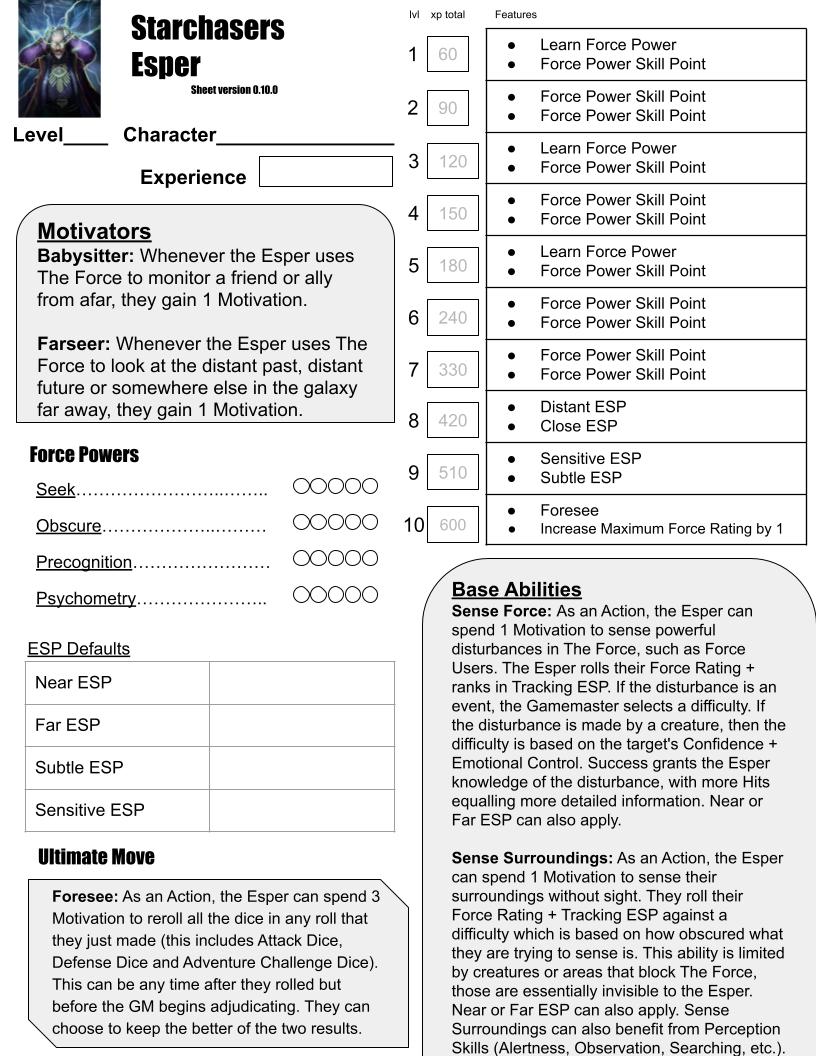
An Esper uses The Force to feel the world around them. They can also witness powerful and impactful future events, or similarly emotionally charged events from the past. As a non-combatative power, this Force Power works best to enhance other martial abilities.
Base Abilities
- Sense Force: As an Action, the Esper can spend 1 Motivation to sense powerful disturbances in The Force, such as Force Users. The Esper rolls their Force Rating + ranks in Tracking ESP. If the disturbance is an event, the Gamemaster selects a difficulty. If the disturbance is made by a creature, then the difficulty is based on the target's Confidence + Emotional Control. Success grants the Esper knowledge of the disturbance, with more Hits equalling more detailed information. Near or Far ESP can also apply.
- Sense Surroundings: As an Action, the Esper can spend 1 Motivation to sense their surroundings without sight. They roll their Force Rating + Tracking ESP against a difficulty which is based on how obscured what they are trying to sense is. This ability is limited by creatures or areas that block The Force, those are essentially invisible to the Esper. Near or Far ESP can also apply. Sense Surroundings can also benefit from Perception Skills (Alertness, Intuition, Searching, etc.).
Ultimate Ability
- Foresee: As an Action, the Esper can spend 3 Motivation to reroll all the dice in any roll that they just made (this includes Attack Dice, Defense Dice and Adventure Challenge Dice). This can be any time after they rolled but before the GM begins adjudicating. They can choose to keep the better of the two results.
Powers
- Seek: The Esper can use The Force to locate a particular person, creature or item that has an impact in The Force.
- Obscure: The Esper can use The Force to hide their own presence from other Force Users.
- Precognition: The Esper can see events in the future, either short-term immediate events, or longer-term impactful events.
- Psychometry: The Esper can see past events that are linked to a specific object or place, especially if there are strong emotions associated with the object or place.
Motivators
The Esper uses the Motivators from the Light Side, Dark Side or Grey Side. It also has the following Motivators:
- Babysitter: Whenever the Esper uses The Force to monitor a friend or ally from afar, they gain 1 Motivation.
- Farseer: Whenever the Esper uses The Force to look at the distant past, distant future or somewhere else in the galaxy far away, they gain 1 Motivation.
Hit Points
The Esper gains 1 Hit Point every level.
Leveling Table
|
Class Level |
Class Features for Level |
|
0 |
|
|
1 |
|
|
2 |
|
|
3 |
|
|
4 |
|
|
5 |
|
|
6 |
|
|
7 |
|
|
8 |
|
|
9 |
|
|
10 |
|
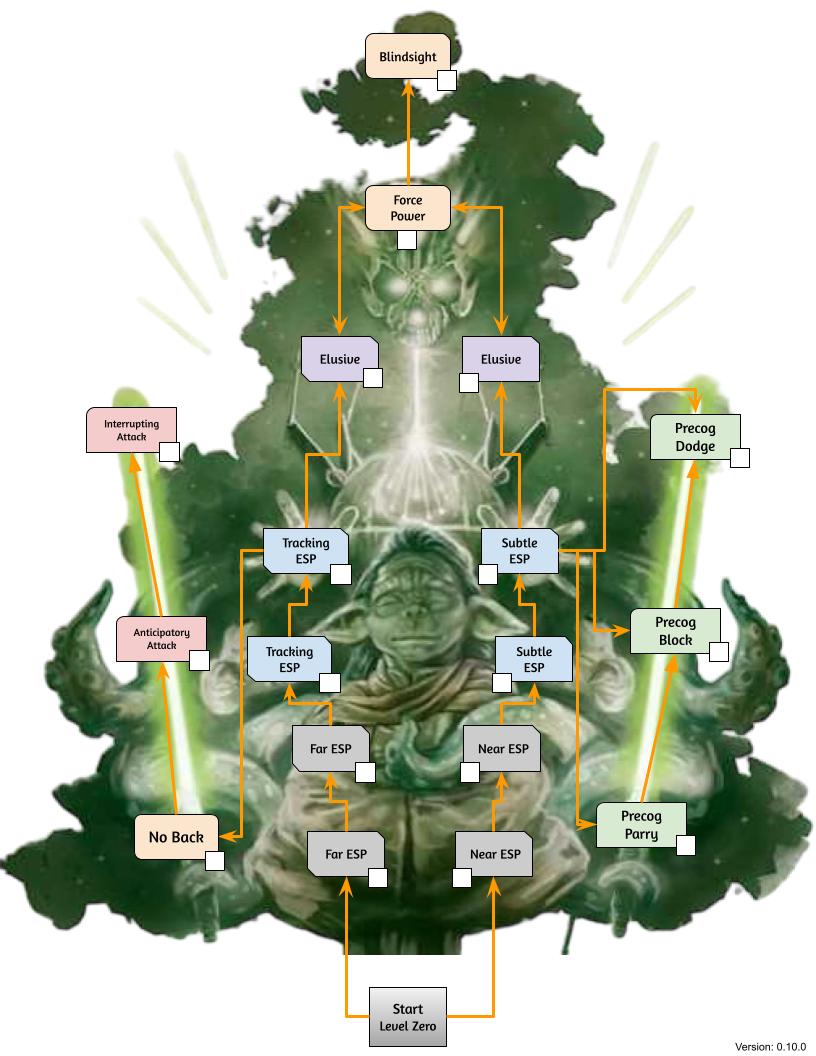
Talent Tree(s)
- Near ESP (x2): ESP powers gain +1 dice per rank for perceiving close events. This works for the Seek and Precognition powers.
- Far ESP (x2): ESP powers gain +1 dice per rank for perceiving distant events. This can affect the Seek and Psychometry powers.
- Subtle ESP (x2): ESP powers gain +1 automatic Hit for the purpose of performing their ESP without being detected. This is especially important for the Obscure power, but can affect any and all Force Powers to some degree.
- Tracking ESP (x2): ESP powers gain +1 dice for finding a target and any subsequent ESP Action to track the same target.
- Elusive (x2): The Esper can count 1 automatic Hit when attempting to hide their presence, powers or their thoughts.
- No Back: The Esper has integrated their abilities into their fighting style such that if they are attacked from behind (the Back Attack bonus is negated), the attacker gains no special benefits. This can even prevent certain abilities from functioning (Backstab for instance).
- Precog Block [Power][Defense]: By spending 1 Motivation, the Esper can use a Reaction for this upgraded Block. They add 1 die to any ability that uses the Block dice pool. The Esper's ranks in either Near ESP or Far ESP can take effect and add bonus dice to the block, depending on whether the combatant is in Melee or Close Range (Near ESP), or further away. The ranks of the appropriate talent are added as bonus dice to the Block.
- Precog Dodge [Quick][Defense]: By spending 1 Motivation, the Esper can use a Reaction for this upgraded Dodge. They add 1 die to any ability that uses a Dodge dice pool. The Esper's ranks in either Near ESP or Far ESP can take effect and add bonus dice to the dodge, depending on whether the combatant is in Melee or Close Range (Near ESP), or further away. The ranks of the appropriate talent are added as bonus dice to the Dodge.
- Precog Parry [Finesse][Defense]: By spending 1 Motivation, the Esper can use a Reaction for this upgraded Parry and adds 1 die to any ability that uses a Parry dice pool. The Esper's ranks in either Near ESP or Far ESP can take effect and add bonus dice to the parry, depending on whether the combatant is in Melee or Close Range (Near ESP), or further away. The ranks of the appropriate talent are added as bonus dice to the Parry. This Parry can be used against Ranged Attacks.
- Anticipatory Attack [Finesse][Attack]: By spending 1 Motivation, the Esper can predict a target's movement. This grants them a +1 extra attack die for their next Attack Action. In addition, the Esper's ranks in either Near ESP or Far ESP can take effect and add bonus dice to the attack, depending on whether the combatant is in Melee or Close Range (Near ESP), or further away. This attack also allows the Esper to attack a target regardless of its Concealment (either Shadow nor Cover Concealment), so long as their attack could reach the target. The Obscure and Invisibility powers directly oppose this and require a Contested Roll before an attack roll is made.
- Interrupting Attack [Quick][Attack]: By spending 2 Motivation, the Esper can predict a target's movement and act before the opponent is ready. The Esper gains the ability to react to another character's Attack after they've decided to do it, but before the dice are rolled for it. They can perform a Attack for this purpose and can add 1 die to the Attack Dice Pool. The Esper's ranks in either Near ESP or Far ESP can take effect and add additional bonus dice to the Attack, depending on whether the combatant is in Melee or Close Range (Near ESP), or further away. If this Attack succeeds (has any uncanceled Hits) the opponent must beat a Resistance check against the damage of the attack as a difficulty. If the target fails, the target's attack is completely interrupted and they lose their Action.
- Blindsight: The Esper can use Sense Surroundings without spending Motivation. If they spend 1 Motivation on it, they gain 1 extra die for their Perception pool(s) for up to 1 minute.
- Force Power: The Telepath learns the final Force Power in this set.
Seek
The Seek power allows the Esper to find specific items or people using The Force over vast distances. The difficulty for this is based more on how emotionally important the person or item is to the Esper, rather than the physical distance involved.
Seek Difficulty Table
|
Item Familiarity |
Person Familiarity |
Difficulty Number |
|---|---|---|
|
Integrated Item (prosthesis) |
Twin / Clone |
1 |
|
Cherished Item |
Lover / Best Friend |
2 |
|
Self-Created Item |
Close Friend / Family |
3 |
|
Personal Item |
Friend |
4 |
|
Known Item |
Acquaintance |
5 |
|
Familiar type of Item |
Friend of Friend |
6 |
|
Well Described Item |
Viewed Hologram of Person |
7 |
|
Unknown Item |
Complete Stranger |
8 |
As an Action, the Esper creates a dice pool with Force Rating + Seek and ranks in either Near ESP or Far ESP, depending on the distance to the target (see table below).
If the number of Hits equals or exceeds the difficulty based on the familiarity, the Esper gets a sense of where the Item or Person is. However they only have a vague idea about where the target is. To get a precise reading the Esper must exceed the difficulty by 3 Hits, or they must spend 2 additional points of Motivation to "home in" on the target.
ESP Focus Distance Table
|
Focus / Motivation Required |
Near / Far |
Maximum Distance Detectable |
Example Size |
|---|---|---|---|
|
1 |
Near |
1 kilometer radius |
A city neighborhood |
|
2 |
Far |
10 kilometer radius |
Anywhere in a small city |
|
3 |
Far |
100 kilometer radius |
Anywhere in a megacity |
|
4 |
Far |
1,000 kilometer radius |
Anywhere on a continent |
|
5 |
Far |
10,000 kilometer radius |
Anywhere on a planet |
|
6 |
Far |
100,000 kilometer radius |
On a planet from high orbit |
|
7 |
Far |
1,000,000 kilometers away |
Any of the moons of a planetary system |
|
8 |
Far |
10 million kilometers away |
From a Hyperspace Lane to a Planetary System |
|
9 |
Far |
100 million kilometers away |
The inner system of a star |
|
10 |
Far |
1 billion kilometers away |
Anywhere in the galaxy |
Once an Esper can tracked their target to the 1 kilometer radius, they must use the Sense Force or Sense Surroundings base abililties to find the target.
Obscure
The Esper can use the Obscure power to hide from a Seeking Esper or the probing of a Telepath. They can also use the power to suppress their innate disturbance of The Force, allowing them to go unnoticed despite their power level. Finally, the Obscure power can be rolled when a biological creature is attempting to Shadow or Track the Esper, which increases the difficulty for this shadowing/tracking by 1 per Hit.
This is an opposed roll against a Seek or Telepathy power roll, and as such the Esper creates a dice pool of Force Rating + Obscure power + ranks of Subtle ESP in Green Defense Dice.
The Esper rolls this defensive pool, with each Evade canceling out a Seekers' or Telepaths' Hit. Ranks in the Elusive talent give automatic Evades. After all normal Hits are canceled, an Evade can cancel a Critical Hit.
If all of the Hits are canceled (including Critical Hits), the Seeker or Telepath is unable to find the Esper, and they cannot try again until they've found another clue or the hidden Esper uses The Force for more than just the Obscure power.
Precognition
The Precognition power can be used to foresee distant, impactful events, as well as detect danger. Because of this it has a few different applications:
- Danger Sense: Notice dangerous events in the immediate future and react quickly
- Force Visions: See powerful, important events in the future
Danger Sense
The Esper can spend a Motivation to add their Force Rating + Precognition power levels to any Initiative roll.
Force Visions
The Esper can occasionally catch glimpses of the future via Force Visions. As an Action the Esper can attempt to gaze into the future. They make a dice pool from their Force Rating + Precognition power + ranks in Near or Far ESP, depending on when they are trying to get a vision for.
The difficulty for these visions is more around how important they are on a cosmic scale they are, and how important they are for this character specifically. To find the appropriate difficulty, the Gamemaster looks at the lowest level for the Event Importance, Event Scope and the Relationship to the Esper for the event in question. The GM does not need to give the player the specific difficulty number, just an indication on whether they receive a Force Vision or not, and then the details of that Force Vision.
Force Vision Difficulty Table
|
Event Importance |
Event Scope |
Relationship to Esper |
Difficulty Number |
|---|---|---|---|
|
Life or Death |
Galactic Scale |
Self |
1 |
|
Severe Injury |
Starsystem Scale |
Twin / Clone |
2 |
|
Major Injury |
Planetary Scale |
Lover / Child / Best Friend |
3 |
|
Emotional Trauma: Terror, Madness, Rage |
Continental Scale |
Close Friend / Family |
4 |
|
Heightened Emotions: Fear, Anger, Hatred |
Megacity Scale |
Friend |
5 |
|
Heightened Emotions: Sadness, Disgust, Melancholy |
City Scale |
Acquaintance |
6 |
|
Heightened Emotions: Annoyance, Embarrassment, Irritation |
Village Scale |
Friend of Friend |
7 |
|
Heightened Emotions: Happiness, Joy, Contentment |
Group Scale (10+ people) |
Viewed Hologram |
8 |
|
No Emotional or Physical Component |
Individual Scale (1-2 people) |
Complete Stranger |
9 |
Psychometry
The Psychometry power lets the Esper gain insight into past events. The Esper must use an Action and touch an item to perform Psychometry. To do this they spend 1 Motivation and compose a dice pool of Force Rating + Psychometry power + Near/Far ESP, depending on how far in the past they are looking.
They then roll the dice against the difficulty. If they beat this difficulty, they find out information. The more uncanceled Hits the Esper has, the more information they gain as to what happened in the past.
To determine the difficulty, the Gamemaster looks at the lowest level for the Event Importance, Event Scope and the Item's Importance in its relation to the event in question. The GM does not need to give the player the specific difficulty number, just an indication on whether they receive a Psychometric Vision or not, and then the details of that Psychometric Vision.
Psychometry Difficulty Table
|
Event Importance |
Event Scope |
Item Importance |
Difficulty Number |
|---|---|---|---|
|
Life or Death |
Galactic Scale |
Integrated Item (prosthesis) / Key Item |
1 |
|
Severe Injury |
Starsystem Scale |
Cherished Item |
2 |
|
Major Injury |
Planetary Scale |
Self-Created Item |
3 |
|
Emotional Trauma: Terror, Madness, Rage |
Continental Scale |
Personal Item |
4 |
|
Heightened Emotions: Fear, Anger, Hatred |
Megacity Scale |
Known Item |
5 |
|
Heightened Emotions: Sadness, Disgust, Melancholy |
City Scale |
Item at the Scene of the Event |
6 |
|
Heightened Emotions: Annoyance, Embarrassment, Irritation |
Village Scale |
-- |
7 |
|
Heightened Emotions: Happiness, Joy, Contentment |
Group Scale (10+ people) |
-- |
8 |
|
No Emotional or Physical Component |
Individual Scale (1-2 people) |
-- |
9 |
Click on the image to open a PDF version.